Naturally, the first thing people ask when thinking about going solar is: How much is this going to cost me today? The fact that the question has served to keep millions of homeowners and businesses off the switch, even when the long-term savings are as clear as day.
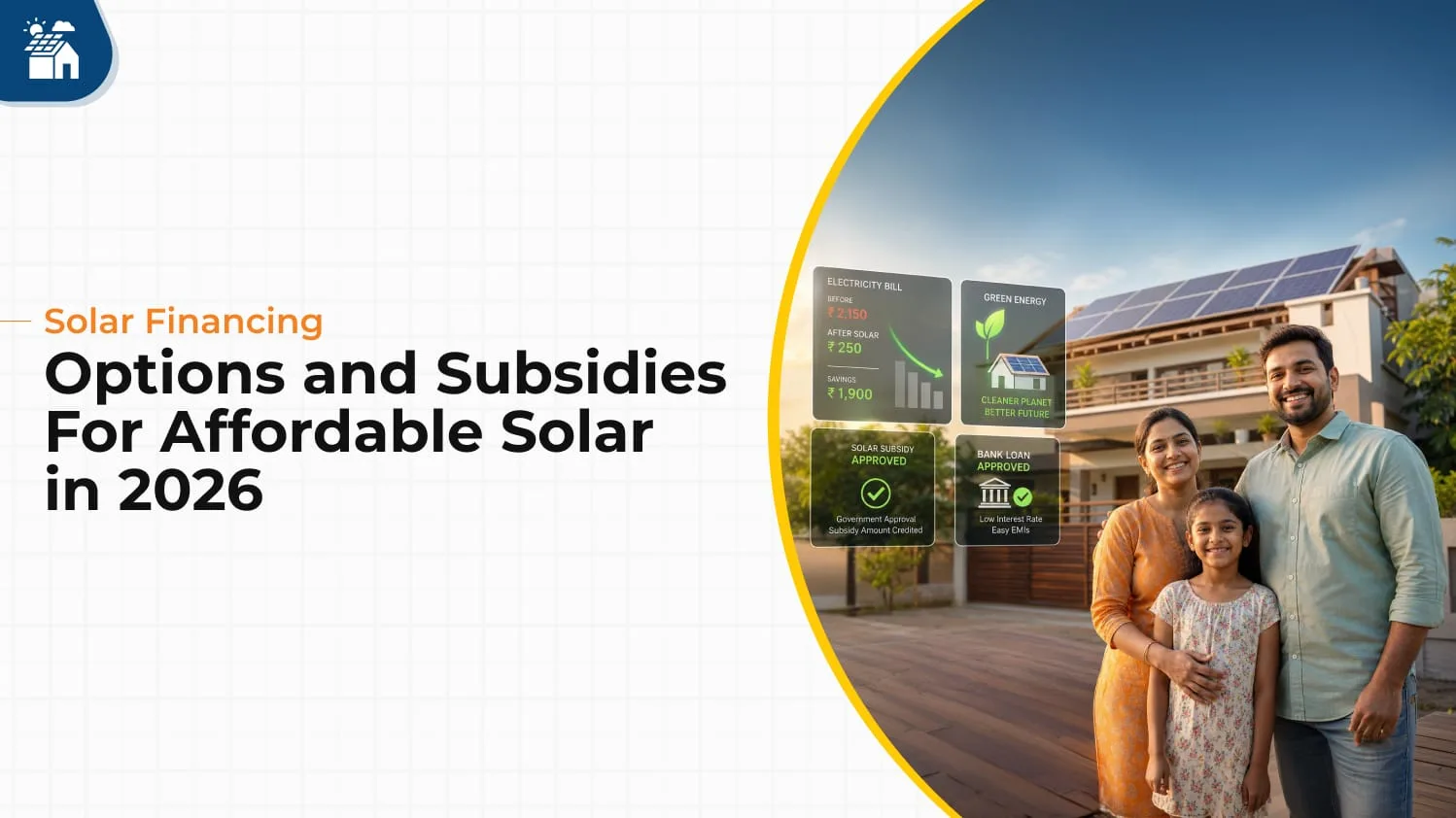
The good news? In 2026, you no longer need to pay the full cost of a solar system upfront. The financial barrier to adopting solar energy is lower than ever, driven by the rapid growth of solar financing services in Gujarat and attractive government-backed incentive programmes. With an increasing range of support options available, both homeowners and businesses across Gujarat can make the switch to solar energy with far greater ease and confidence than before.
This guide will break down each of the major options available to you, whether you are a homeowner who wants to cut down on electricity bills, a business trying to calculate ROI or a developer planning a large-scale solar project financing.
Why Solar Financing Matters More Than Ever in 2026
Solar panels have also been made available at a reduced price of more than 90% in the past 10 years. However, a domestic installation will still normally cost between ₹4,00,000 and ₹12,00,000 in India, and between 15,000 and 30,000 in most Western markets. To a majority of households, it is not a mere buy.
- This is exactly where the systematic solar energy financing processes come in, which decreases initial expenses
- The correct financing structure will enable you to begin to generate clean energy now, rather than waiting a few years to amass some money
- Frequently, the monthly bills are less than your current electricity bill
And with world solar capacity already approaching 5 terawatts in 2026, governments around the world are redoubling efforts to make use of incentives so as to accelerate adoption. It is a true opportunity; you just have to know where to seek it.
Understanding Your Solar Financing Options
Solar financing is not made equal. The appropriate structure is determined by your ownership objectives, credit report, and the speed at which you need to realise a payback. This is a list of the key routes that will exist in the year 2026.
1. Solar Loans
Solar panel installation financing has become the most popular financing method to install solar panels today. You finance the entire system cost through a bank, NBFC or a special purpose renewable energy lender, mount the panels and pay in easy monthly instalments usually over 5 to 20 years.
The most important benefit: you will be the owner of the system from the very first day. It implies that all the tax credits, subsidy benefits and energy savings are passed directly to you.
What to look for in a solar loan:
- With interest rates of 7 to 12% per year in India
- Zero prepayment penalties
- The tenures of loans were based on the duration of the system (typically 25 years)
- Access to financial support programmes for lower-income applicants
2. Power Purchase Agreements (PPAs)
A PPA is perfect when a business and an institution are interested in having zero capital expenditure. The system is installed and maintained by a specialised renewable energy provider at no initial cost on your property. You just accept to take the electricity produced at a fixed and reduced rate, which is usually 20 to 30% lower than grid tariffs.
To schools, hospitals, factories and business buildings, this model has made solar project financing in Kutch affordable without having to touch on working capital.
3. Solar Leases
Like a PPA, a solar lease allows you to use a solar system in exchange for fixed monthly payments without owning the solar system. Although you will not directly pocket the subsidy benefits, you will have direct benefits on electricity bills without having to spend on it directly.
4. PACE Financing (Property Assessed Clean Energy)
PACE is available in a number of states in the US and is spreading to other parts of the world, where it allows you to repay your solar investment by adding it to your property tax bill. The property, but not the individual, secures the loan, which is why it is a wise choice for those who might refinance or sell the property within a few years.
Government Solar Subsidy Programmes in 2026
One of the most effective and underused tools for lowering the cost of solar is subsidies. On the costs of installing systems, the government can rebate a quarter to half of the final cost, depending on the area and the size of the system installed.
1. India: PM Surya Ghar Muft Bijli Yojana
Introduced in 2024 and active in full in 2026, India has a flagship program of rooftop solar subsidies to provide up to ₹78,000 in direct financial assistance to residential installations. The programme aims to reach 10 million households and is aided by special solar loan assistance through the nationalised banks at concessional rates.
Key benefits at a glance:
- Systems up to 3 kW have a subsidy of up to 40%
- 20% subsidy for systems between 3 kW and 10 kW
- Solar installations are subsidised by partner banks in the form of loans
- Free electricity of up to 300 units per month to eligible households
2. India: Grid Connected Rooftop Solar Programme
This programme, launched by the Ministry of New and Renewable Energy, contributes to the massive adoption of rooftop solar in residential sectors. It grants central financial aid to households and encourages the adoption of empanelled vendors as a means of quality installations. The scheme also promotes the participation of DISCOM so as to facilitate approvals and grid connectivity.
Solar Funding Options For Businesses and Large-scale Projects
Solar is no longer just a residential play. The commercial and industrial (C&I) adoption is increasing at a higher rate than any other segment. The financing structures are more advanced, yet the returns are proportionate to the returns. In business terms, some of the best solar funding models are:
- Commercial bank term loans with solar-specific underwriting
- Green bonds and ESG-based funding of listed companies
- Utility-scale solar project financing structure
- Indian MSME solar schemes are providing financial assistance of up to 1 crore without any collateral
- Business PPAs and Corporate PPAs are intended to achieve net-zero commitments by businesses
A manufacturing facility, such as a recently-financed 500 kW rooftop system by a manufacturing facility, claimed government incentives of up to 500 kW of system capacity, obtained a term loan with a nationalised bank, claimed state-level renewable energy incentives, and reduced its payback period to less than four years.
What to Avoid When Claiming Solar Incentive Schemes
Most of the applicants miss out on money just because of some errors which can be avoided. Watch out for:
- Failure to employ an empanelled installer may result in subsidies being demanded by vendors who are approved by MNRE
- By skipping the pre-approval process, apply to receive solar subsidy assistance before installation, not after installation
- Selecting a loan without verification of prepayment terms
- Ignoring state-level incentives that are superimposed on central schemes
- Disregarding battery storage incentives, now a part of most solar system financing packages
Conclusion
Making the switch to solar in 2026 is no longer a question of whether you can afford it or not; it is a question of which financing path fits you best. The infrastructure to get it to happen is solidly in place, whether you decide to go with a solar loan, a PPA, a government incentive programme or a combination of all three.
The trick is to collaborate with a reliable partner who is aware of the technical and financial aspects of adopting solar. At White Desert, we assist homeowners, businesses and developers in navigating the solar panel installation financing in India, accessing financial support to adopt solar, and facilitating a solar future which is financially viable on the first day.
The sun is not going anywhere. The savings are factual. The capital is prepared. All that’s left is your first step.