
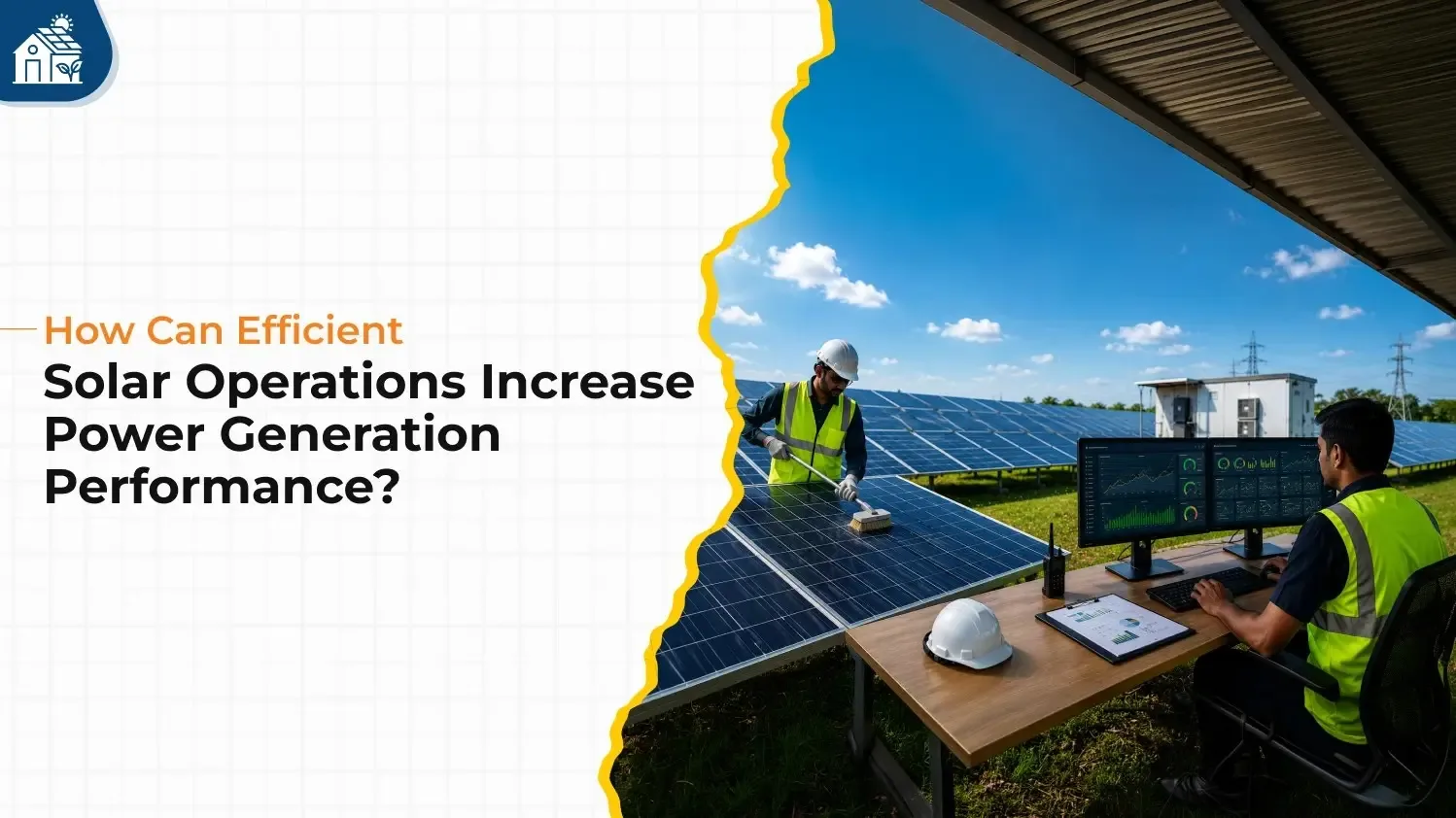
Solar energy has moved far beyond the experimental phase. In 2024, global solar capacity crossed 1.6 terawatts, and projections from the International Energy Agency (IEA) suggest it will nearly triple by 2030. But raw installed capacity is only part of the story. What happens after the panels go up and how a plant is run day-to-day determines how much of that capacity actually converts into revenue and grid-stable power.
This is where modern solar plant management software and effective solar operations and maintenance services play a critical role. The gap between a well-operated plant and a poorly managed one can be startling. Studies by Wood Mackenzie show that underperforming solar assets lose between 10% and 20% of their potential annual generation due to avoidable operational failures. That’s not a technology problem. It’s an execution and management problem.
So what does efficient solar operations actually look like, and why does it matter so much?
What Does “Performance” Mean in a Solar Plant?
Before getting into the how, it’s worth pinning down what we mean by performance. In the solar industry, performance ratio (PR) is the standard benchmark: the actual energy output divided by the theoretical output under ideal conditions. A brand-new plant in a high-irradiance zone such as Kutch, Gujarat, might have a PR of 80 to 83%. Poor O&M practices, unresolved faults, and soiling losses can drag that PR down to 70% or lower within just a few years.
The key performance variables include:
- Availability: what percentage of the time the plant is operational
- Soiling loss: dust and dirt accumulation reducing panel efficiency
- Clipping and inverter losses: power electronics running out of optimal range
- Degradation rate: how fast panels lose efficiency over time
Each of these is manageable. None of them manages themselves.
How Solar EPC Execution Shapes Long-Term Performance
Most plant owners don’t realise how much long-term performance is locked in during construction.
End-to-end solar project implementation covering civil construction, module mounting structures, cable installation, inverter setup, and grid integration. When done precisely, the plant starts at a strong baseline. When shortcuts are taken, those errors quietly drag output down for the next 25 years, which is exactly why professional solar EPC execution services matter from day one, not just at handover.
Loose cable terminations, wrong tilt angles, unverified string configurations these don’t announce themselves immediately. They compound.
According to a 2023 report by IEEFA, installation quality ranks among the top three factors in long-term yield variance across South Asian solar projects. Quality execution sets the baseline operations can build on, not one they have to recover from.
The Role of Preventive vs. Reactive Maintenance
The difference between a high-performing plant and an average one often comes down to one question: do you fix problems before or after they happen?
1. Reactive maintenance
Waiting for the alarm. A string trips, a technician is dispatched, and the plant has already lost generation hours. In a 10 MW plant, one inverter fault left unresolved for 48 hours can cost several thousand units of output.
2. Preventive maintenance
Runs on schedules and data. Thermographic inspections catch hotspots before cells short. Insulation testing flags degraded cables before they trip protection. Cleaning happens on a data-driven schedule, not when someone notices visible dirt.
3. Solar operations and maintenance services
Built on preventive protocols consistently achieve availability of 98 to 99%, versus 94 to 96% for reactive models. That gap translates to hundreds of thousands of rupees in recovered revenue annually for a mid-sized plant.
When solar operations and maintenance services Kutch are structured properly, they also extend inverter life and reduce DC cable degradation over the long term.
Data-Driven Monitoring: From Alerts to Actionable Intelligence
Modern solar plants generate enormous volumes of data from inverters, weather stations, energy meters, and string-level monitoring boxes. The challenge isn’t collecting data. It’s turning it into decisions fast enough to matter.
Effective solar plant operations services use SCADA (Supervisory Control and Data Acquisition) platforms combined with performance analytics tools that do more than display dashboards. They:
- Flag underperforming strings against expected irradiance-adjusted benchmarks
- Track specific loss categories (soiling, downtime, curtailment) separately
- Generate automated work orders when fault patterns recur
- Compare actual PR against P50 and P90 projections from the original energy assessment
According to BloombergNEF’s 2024 Solar O&M benchmark report, plants using advanced analytics reduce unplanned downtime by an average of 34% versus those on basic SCADA alone.
In Kutch, where temperatures cross 45°C in summer, and dust events from the Rann can cause rapid soiling, generic protocols don’t cut it. Site-specific solar power plant management strategies consistently achieve superior performance compared to standardized procedures imported from different geographies.
Asset Lifecycle Management: Thinking in Decades
A solar plant is a 25-year asset. The inverters will need replacement around years 10 to 12. The DC cables may need termination checks every five years. Panel warranties expire, and actual degradation rates diverge from warranted rates over time.
Lifecycle-aware operations teams that take lifecycle management seriously build capital expenditure (capex) forecasts for major replacements into the project from the start. They track degradation against original PR guarantees, flag when actual module performance falls below contractual thresholds, and manage warranty claims with manufacturers before the window closes.
This is especially relevant for Independent Power Producers (IPPs) and funds that acquired solar assets as investments. The difference between an asset that delivers its PPA obligations comfortably and one that misses targets often comes down to whether lifecycle planning was integrated into the O&M model or left as an afterthought.
Performance Benchmarks: What the Data Says
| Metric | Reactive O&M Model | Preventive O&M Model |
| Plant Availability | 94 to 96% | 98 to 99% |
| PR Degradation (Year 5) | 4 to 6% drop | 1 to 2% drop |
| Unplanned Downtime Events | 12 to 18/year | 3 to 5/year |
| Soiling Loss (Semi-arid zones) | 5 to 8% | 2 to 3% (scheduled cleaning) |
| Inverter MTBF (Mean Time Between Failures) | 18 to 24 months | 36 to 48 months |
The numbers make a clear case: operational discipline is not a soft benefit; it has a direct, measurable impact on generation and revenue.
Training, Protocols, and On-Ground Execution
Technology only works as well as the people behind it.
Field teams trained in lockout/tagout procedures, arc flash safety, inverter fault diagnosis, and string troubleshooting resolve faults faster and make fewer errors. When a technician arrives at an inverter fault already knowing the diagnostic sequence, it gets cleared in 45 minutes instead of three hours.
Standard operating procedures (SOPs) for common faults are what make that possible.
This is also where solar project execution services feed back into daily operations. Plants built with clear as-built documentation, properly labelled equipment, and accurate commissioning reports give field teams an information advantage from the first day of operations.
Conclusion
Efficient solar operations are not incidental to plant performance; they are the primary driver of it. From the quality of construction that solar project execution services deliver at commissioning, to the discipline of preventive schedules, real-time analytics, and lifecycle planning that defines mature operations, every layer compounds over a 25-year asset life.
At White Desert, our approach to solar EPC and operations in the Kutch region is built around this principle: the plant you commission is the baseline, and everything after that is what determines real returns. If you’re developing, acquiring, or operating a solar asset and want to close the gap between installed capacity and actual generation, the answer starts with how you run it every single day.