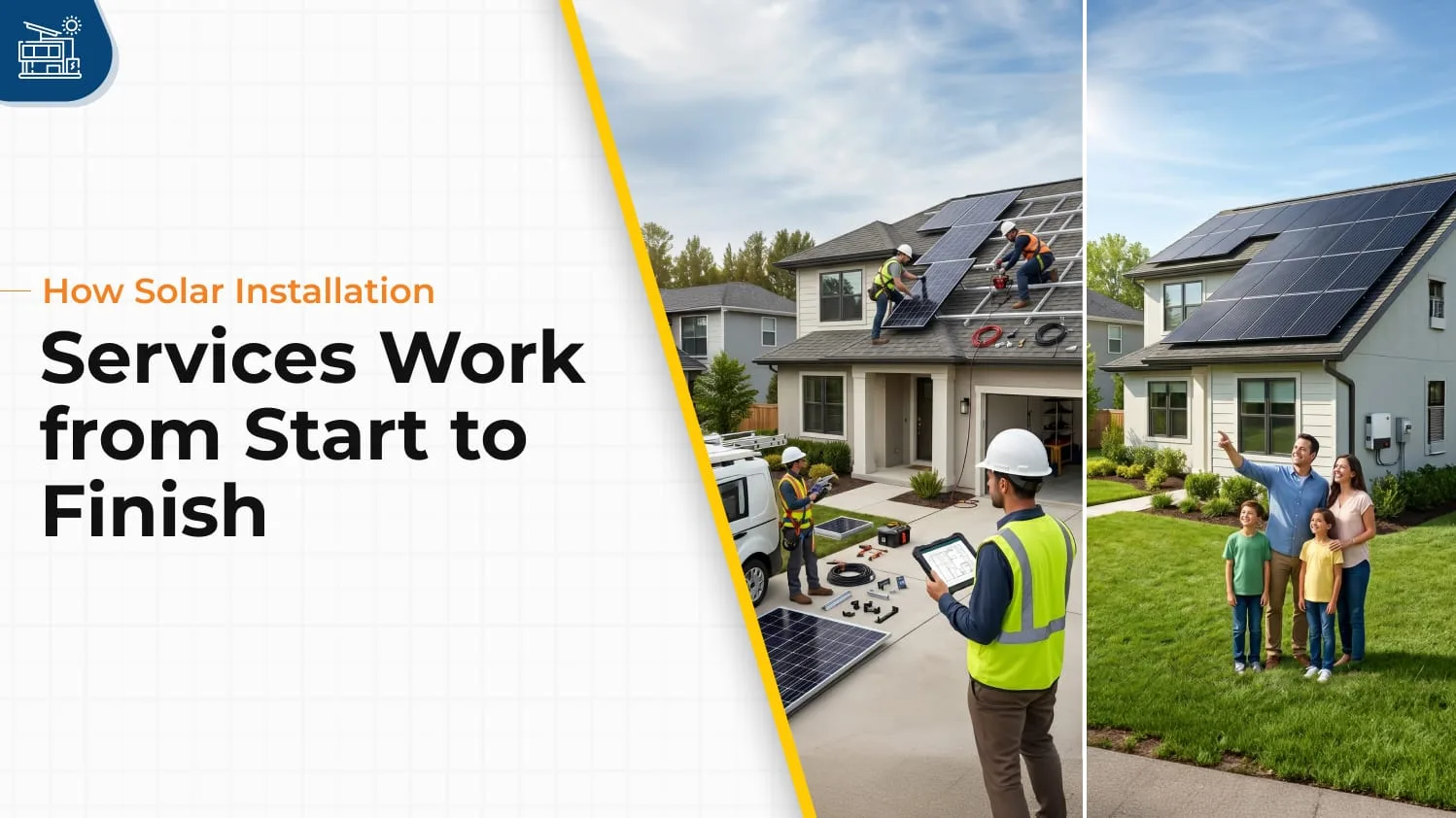
Solar panels don’t install themselves. There is a maze of construction between the committing of a contract and the switching of a switch on your new solar system, which will either result in your investment yielding expected returns or prove to be a frustration.
The performance of solar installation services in Kutch directly influences the performance of the system over the next 25 years. An effective installation will maximise energy production, reduce maintenance nightmares, and provide safety. Even high-quality parts do not ensure good performance because the installation is not done properly, which causes early failures and can be hazardous.
The knowledge of the entire installation life cycle assists you in evaluating the contractors, making realistic expectations and also implementing your project to the utmost standards possible.
Phase 1: Pre-Installation Planning & Site Preparation
Prior to the erection of a single panel, solar plant construction services in Gujarat are done by professional groundwork.
Site Assessment and Survey
Design assumptions are verified by detailed on-site evaluation:
- Physical Tests – Checking of space available against layouts
- Structural evaluation – Roof load-bearing capacity test on rooftop systems
- Shadow analysis – Checking that there are no new obstructions since the first survey
- Access assessment – Planning equipment and material access routes
- Utility coordination – Verifying grid connection points and specifications
- Safety planning – recognising hazards and setting up safety measures
This stage identifies the problems at hand before it can turn out to be an expensive surprise during the project.
Site Preparation and Logistics
Preparation of the site to be built includes:
- Material staging areas – Designating safe areas where components can be kept
- Access road preparation – facilities to make heavy equipment available to the areas of installation
- Temporary power set-up – installation of construction power
- Introduction of a safety perimeter – fencing and signage for workers and the population
- Permits and approvals – The acquiring of building permits and electrical clearances
- Schedule coordination – matching the material delivery to construction milestones
Hurried assembly causes time wastage, faulty parts and accidents.
Phase 2: Civil Work and Foundation Construction
The ground-mounted systems and certain rooftop systems involve a lot of civil engineering.
For Ground-Mounted Solar Plants
The literal foundation of your solar investment is foundation work:
- Land levelling and grading – developing the best surface conditions
- Soil testing – Ensuring load-bearing capacity is as per design
- Foundation excavation – Excavation of foundation to prescribed depths with which to mount the bases of the structures
- Pouring of concrete – duration of installation of foundations
- Cable trenching – Trenching of electrical runs underground
- Drainage Systems – Eliminating the buildup of water around the equipment
- Road construction – Construction of access roads to maintenance vehicles
Good civil works will help avoid expensive problems such as foundation settling, water damage, and structural instability.
For Rooftop Installations
Civil considerations for rooftop systems are different:
- Waterproofing test – Watertightness of the roof will not be jeopardised
- Penetration planning – Reduce and adequately seal roof penetrations
- Structural reinforcement – adding supports if load capacity is marginal
- Installation of walkways – Provision of safe maintenance access routes
- Edge protection – Fall protection systems during installation
Professional solar system installation companies in India treat your roof as carefully as the solar system itself.
Phase 3: Mounting Structure Installation
The framework on which your panels are attached must be a skeleton that is set up accurately.
Module Mounting Framework
The installation of mounting structures has specific procedures:
- Layout marking – Accurately marking mounting rails according to design drawings
- Assembling Structure – Assembling the structure according to the manufacturer’s specifications
- Alignment check-up – With a level and theodolites to give precise positioning
- Fastener torque – Tightening bolts to recommended values, not more or less
- Corrosion protection – Making sure that all connections are anti-corrosion
- Wind load compliance – Ensuring that attachments are in line with structural calculations
Even small errors in alignment multiply in large arrays, decreasing performance and causing uneven mechanical stress.
Quality Checks During Mounting
Professional installers verify:
- Accuracy of tilt angle – Within design specifications (usually, within the 2-degree range)
- Stability of row spacing – Avoiding inter-row shading
- Foundation integrity – No confirming cracks or movement
- Electrical continuity – earthing connections test
- Clearance in module placement – providing sufficient spacing for thermal expansion
These checks avoid problems that cannot be fixed once they have been installed on the panel.
Phase 4: Solar Panel Installation and Array Configuration
Panel installation entails both handling structures and doing it carefully and precisely.
Module Installation Process
The installation of each panel has systematic steps:
- Eyes-on inspection – Before mounting, checking shipping damages
- Handling properly – Large modules should be handled using suction lifters to avoid micro-cracks
- Safe mounting – Use of appropriate clamps and fixings
- Alignment precision – Making sure that there are no gaps or straight rows
- Orientation check-up – Checking the right polarity and direction of the panel
- Serial number records – Recording the location of each panel to enable tracking of the warranty
Skilled solar construction companies in Kutch teams install 300-400 modules daily per team while maintaining quality standards.
DC String Configuration
The panels are connected by wires into strings as per design requirements:
- String sizing check – Correspondence between design and check
- Polarity testing – checking positive/negative associations
- MC4 connector installation – Making sure that connections are weather-tight and secure
- Cable management – Routing DC cables to prevent damages and reduce losses
- String testing – Short-circuit current and open-circuit voltage
- Labelling – Marking down to facilitate troubleshooting in the future
Poor stringing leads to power imbalances, which lower the performance of the array.
Phase 5: Electrical Installation and System Integration
The electrical backbone bridges the gap between solar generation and usable power.
DC Electrical Work
DC systems are unique to experience.
- DC combiner box installation – String collection points at central points
- DC cable routing – Based on the shortest practical paths with correct support
- Circuit protection – Fitting fuses or MCBs to each string
- Surge protection – Lightning arresters protecting against transients
- Polarity check – testing prior to energising system
- Insulation testing – Checking that there are no ground faults or shorts
AC Electrical Infrastructure
DC is converted to grid-compatible AC power using inverters:
- Inverter mounting – Mounting to ensure the best cooling and accessibility
- Installation of AC cable – 3-phase distribution in a balanced condition
- Transformer installation – Step-up transformers to connect to the grid (where necessary)
- Installation of metering – net meters or gross meters according to utility requirements
- Protection systems – MCCBs, isolators and safety interlocks
- Monitoring devices – communication gateways and sensors
Earthing and Lightning Protection
Many important systems to consider when it comes to critical safety:
- Installation of earthing grids – copper or GI earthing strips
- Equipment earthing – inverter connection, structure, and panel connection
- Resistance testing – Checking earth resistance less than 5 ohms
- Lightning arresters – Guarding against lightning
- Equipotential bonding – doing away with potential differences
Earthing is done correctly to eliminate the risks of electric shocks and to save costly equipment.
Phase 6: Grid Connection and Net Metering Setup
Connection to the utility grid entails regulatory compliance and technical accuracy.
Grid Integration Process
Professional solar plant installation company in Gujarat teams handle:
- Utility coordination – Schedule meter installation and inspection
- Grid synchronisation – Voltage and frequency compatibility
- Anti-islanding protection – Avoiding backfeed in the event of grid outages
- Power quality check-up – Checking voltage, frequency and harmonic level
- Net metering setup – configuring bidirectional energy metering
- Subsidy documentation – Presenting necessary certificates to claim incentives
The requirements of each state and DISCOM are different. Local experience averts the delays in approvals.
Inspection and Approvals
Several tests are done prior to final commissioning:
- Approval of electrical inspector approval – confirming the electrical codes
- DISCOM test – Utility verification permission prior to interconnection
- Fire safety clearance – Commercial and industrial systems
- Structural certification – Sign-off of rooftop installations by engineers
- Environmental clearances – large ground-mounted plants
Lost or unfinished documentation will slow down the completion of a project by weeks or months.
Phase 7: Testing, Commissioning and Performance Verification
The last stage assures that everything is as planned.
Comprehensive System Testing
Performance is verified during extensive testing before handover:
- String-level testing – measuring voltage, current and resistance per string
- Functional testing of the inverter – checking all protection and efficiency
- SCADA verification – checking that the monitoring system report is accurate
- Performance ratio testing – comparing the generation that happened with the expected generation
- Testing of safety systems – emergency shutdowns, fire protection, and alarms
- Grid compliance testing – voltage regulation, power factor, and harmonics
Documentation and Training
Installation by a professional includes full documentation:
- As-built drawings – Reflecting any changes from the original design
- Operation and maintenance – manuals of equipment
- Warranty certificates – all component warranties correctly registered
- Reporting Commissioning – Baseline performance data
- O&M processes – Maintenance procedures and guidelines
- Training of the owner – Training on the use of monitoring systems and basic troubleshooting
This is a document that will be invaluable in maintenance and warranty claims in the future.
Installation Considerations Across Applications
Various projects have different installation methods.
Residential Rooftop Systems (1-10 kW)
Home installations prioritise the following:
- Aesthetics – Tidy cable runs and attractive layouts
- Little disturbance – Installation within 1-2 days
- Roof protection – maintaining structure and waterproofing
- Safety of the homeowner – Sufficient barriers during construction
- Easy to use – user-friendly monitoring interfaces
Commercial Solar Systems (10-500 kW)
Business installations require:
- Operational continuity – Fitting with business continuity
- Phased commissioning – commissioning one part at a time
- Professional appearance – Reflecting on corporate image standards
- Quick implementation – adhering to short project schedules
- Integration planning – Liaising with building management systems
Industrial & MW-Scale Plants (500 kW+)
Large projects demand:
- Rigour of project management – Daily progress reporting and tracking
- Multi-crew coordination – Safety of 50+ workers
- Quality control mechanisms – checks at each point
- Heavy equipment skills – cranes, excavators, and pile drivers
- Regulatory navigation – Dealing with various approval authorities
The scales demand varying levels of expertise and project management skills.
Common Installation Mistakes That Cost Performance
We have witnessed how these mistakes have hurt so many solar investments:
- Poor grounding – providing shocks and equipment susceptibility
- Over-torqued connections – MC4 connector cracking resulting in failures
- Poor cable management – shading, abrasion and loss of voltage
- Poor cooling clearance – reduced life of overheating inverters
- Hurried commissioning – Years of legacy configuration errors
- Poor documentation – uses incomplete documentation; it makes future maintenance hard and filing any warranty claims impossible
Professional installation prevents these with systematic quality control and proficient supervision.
Why Professional EPC Contractors Matter
The difference between professional solar installation services in Kutch and basic installers shows clearly:
| Aspect | Basic Installer | Professional EPC |
| Team skills | Semi-skilled labor | Certified technicians |
| Quality control | Visual inspection only | Multi-stage testing protocols |
| Safety compliance | Basic PPE | Comprehensive safety programs |
| Documentation | Minimal records | Complete as-built packages |
| Warranty support | Limited responsibility | Full system performance guarantee |
| Project timeline | Flexible, often delayed | Fixed schedule with penalties |
The upfront cost difference disappears quickly when professional installation delivers higher performance and fewer problems.
White Desert Power’s Installation Excellence
Our solar plant construction services in Gujarat combine technical expertise with practical execution experience. We’ve installed systems across Kutch’s challenging environment of extreme heat, dust storms, and coastal salinity.
Our installation crews are trained electricians and civil technicians that are specifically trained in solar building. All projects comply with written quality guidelines, safety measures, and testing standards.
We do not simply put up solar panels; we design power plants which are optimally designed and which are able to endure the harsh environment in Gujarat. Our standards of installation are not compromised at 3 kW home systems, 50 MW solar parks and above.
Whether you have a residential rooftop project in Bhuj or an industrial-scale plant on the ground in Kutch, our construction knowledge will make sure your solar investment is installed once.
Good solar systems are not only designed properly; they also have been installed with care and are tested and commissioned. Begin your solar experience with a high-quality installation that provides guaranteed performance.