The commissioning date is a holiday to most solar investors. The panels are installed, the inverters are running, the meters are rotating, and it seems that the work has been completed. It isn’t.
What no one tells you about ribbon-cutting: a solar plant that lacks structured operations and maintenance loses 15 to 25% of its potential energy output in a year. Silently, month after month, dust, heat stress, inverter faults, vegetative shading, and degraded connections are feeding on your returns.
Solar O&M focuses on continuous performance monitoring and preventive maintenance rather than relying on reactive repair calls when issues arise. It is a performance management science that invests your money with a 25-year payback period.
This guide is authored for business owners, industrial facility managers, and commercial clients who have already invested in solar or are considering long-term solar project collaborations. At the end, you will know what professional solar operations and maintenance services really entail, why they are important, and what to consider in an O&M partner.
What Is Solar O&M And What Does It Actually Include?
Solar plant operations services include all that transpires after installation so that your system is functioning at its designed capacity or close. Imagine it like you imagine a car service plan, but your solar plant is operating 365 days a year and is making money each hour the sun is shining.
A comprehensive O&M programme typically includes:
- Preventive maintenance: Cleaning, inspection, torque check, thermal inspection
- Corrective maintenance: Fault diagnosis and repair in case of performance decline
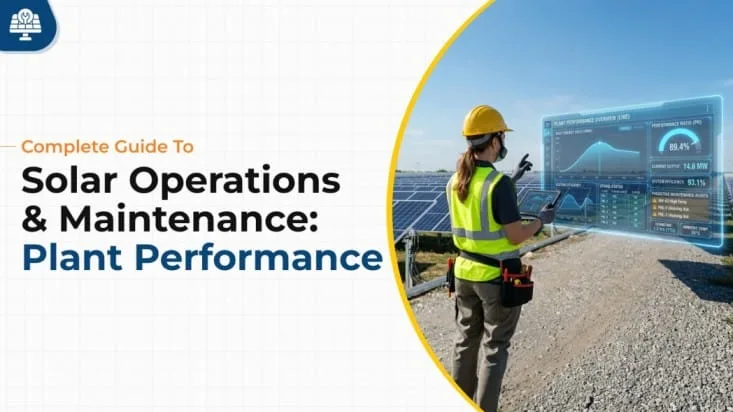
- Performance measurement: Data gathering and analysis of energy yield in real-time
- Asset management: Documentation, compliance reporting, warranty management
- Remote monitoring: 24/7 SCADA or IoT remote monitoring of generation
The principles are the same whether you have a small rooftop or a multi-megawatt plant; it is only the size that alters.
Why O&M Is a Business Decision, Not a Technical One
We can understand this with simple numbers. A 100 kW commercial rooftop solar system in Gujarat typically generates savings or revenue of around ₹8 to 10 lakh per year. Even a 1% drop in performance efficiency can lead to losses of ₹8,000 to 10,000 annually. If system performance falls by 10% due to issues such as dirty panels, faulty string inverters, or corroded DC cables, the annual loss can reach ₹80,000 to 1,00,000.
Over a 25-year asset life, these losses accumulate significantly, turning into a major financial impact rather than a minor maintenance expense.
This is why solar O&M is increasingly prioritized by investors and industrial users. It is now planned from the project’s early stages and often included within solar EPC execution services.
Effective O&M ensures higher long-term returns, as preventive maintenance is far more cost-efficient than emergency repairs and lost energy generation.
The O&M Lifecycle: From Commissioning to Year 25
Being aware of the times when O&M activities occur enables you to create budgets and performance expectations.
Year 1 to 2: Stabilisation Phase
- The initial performance data is set
- Snags in commissioning are pointed out and addressed
- Module, inverter, and BOS warranties are proactively maintained
- Solar performance dashboard is set up and distributed to clients
Year 3 to 10: Optimisation Phase
- The annual degradation rate (usually 0.5 to 0.7 per year) is observed and compared
- The health checks that inverters undergo are in is significant to inverters with a 10 to 15-year lifespan
- String-level monitoring detects poorly performing areas before they cascade
- Plant management comes into play in ground-mounted solar execution projects
Year 11 to 25: Asset Management Phase
- Significant parts replacement will be carried out (inverters, cables, junction boxes)
- Upgrades of module technology can be considered
- O&M data is used in repowering or capacity expansion decisions
- Valuation of assets and refinancing are backed by energy yield reports
Rooftop vs. Ground-Mounted: O&M Is Not Uniform for A
1. Rooftop Solar O&M
Solar surveillance on rooftops requires a different way of operation compared to utility-scale plants, especially when integrated with rooftop solar monitoring systems. Access controls are complex, building maintenance programs, and co-sharing of roof space.
Key considerations:
- Cleaning of the panel should be in line with the building operation (usually at night or on weekends)
- Monitoring of the load is essential; rooftop installations should not connect to the grid without authorization
- The mounting system should be subjected to structural checks, particularly after the monsoon
- Shadow analysis must be repeated every year because of the changing surrounding structures
2. Ground-Mounted Solar O&M
Projects that deploy solar on a large scale (1 MW and above) attract more land management challenges in addition to technical O&M.
Key considerations:
- Control of vegetation beneath and surrounding panel rows
- Security and monitoring along the perimeter (particularly in remote areas)
- Maintenance accessibility of roads to maintenance cars
- Wildlife and environmental law in designated areas
What Professional Solar O&M Partners Actually Do
By contracting a group with a history of successful solar project execution services, you are not contracting technicians; you are contracting an assurance.
The difference between professional O&M and ad-hoc maintenance is as follows:
1. Performance Ratio (PR) Monitoring:
It is the monitoring of PR as compared to weather-adjusted standards, rather than raw output figures. A plant that produces as projected during a sunny month can equally perform poorly if PR has dwindled
2. Thermal Imaging:
Drone-based IR inspections are conducted annually or twice a year to detect hotspots in modules, connection points, and combiner boxes that cannot be seen with the naked eye and are dangerous unless addressed.
3. Predictive Maintenance:
With the help of AI-based tools and SCADA data, senior O&M teams can anticipate the system inverter failure 2 to 4 weeks before it happens, planning the replacement at a time with low irradiation to reduce the loss of generation
4. Compliance & Reporting:
DISCOM compliance, net metering checks, MNRE reporting, and insurance documentation are all handled by the O&M team, so you do not have to worry about this as much
Industrial Solar O&M: Higher Stakes, Higher Standards
In the case of factories, warehouses, and industrial facilities, there is a different risk profile for the industrial solar project execution. The shutdown is not only unplanned and thus results in lost generation income, but it can also impact the production schedules of multiple solar assets.
Industrial O&M requirements include:
- Zero-downtime maintenance procedures: Production shutdowns worked around
- Arc flash safety compliance: All O&M personnel are trained to NFPA 70E or similar
- SCADA integration with plant: Solar generation data into facility energy management systems
- Account management: Having one touch point who knows your production schedule
An example of a textile manufacturer with a 2 MW rooftop system will not be able to afford inverter downtimes during high export periods. Their O&M agreement has a 4-hour response SLA guaranteed and on-site spare inverter modules.
How to Evaluate an O&M Partner: 6 Questions to Ask
Before entering into an O&M agreement, independent or combined with solar EPC execution services, request your potential partner:
- What is your assured Performance Ratio (PR), and what are the repercussions of non-performance?
- Do you offer 24/7 solar system monitoring and remote diagnostics?
- How long does it take you on average to respond to corrective maintenance?
- What do you do when there are warranty and out-of-warranty inverter changes?
- Do you have liability cover in case of on-site maintenance works?
- Will you give industrial/commercial clients the same sizes of plant?
An effective provider of solar system management services will not be afraid to answer all six questions and give a written confirmation of their answers.
Conclusion
Building a solar plant is a one-time activity, but operating it efficiently is a 25-year discipline.
The difference between a plant that delivers 90% of its expected lifetime yield and one that delivers only 70% is not technology; it is operations. Long-term efficiency is guaranteed by routine system maintenance, a clearly defined maintenance schedule, and constant monitoring of the performance of the system with the help of proactive teams that identify and address issues before they can turn into failures.
If you are evaluating solar as a long-term investment for a commercial rooftop, industrial facility, or large-scale installation, your operations and maintenance plan should be defined before execution begins. The most effective solar project execution service providers integrate this planning from day one.At White Desert, we believe solar panels convert sunlight into electricity, and a strong O&M system ensures that electricity consistently receives reliable financial returns over the entire project lifecycle.