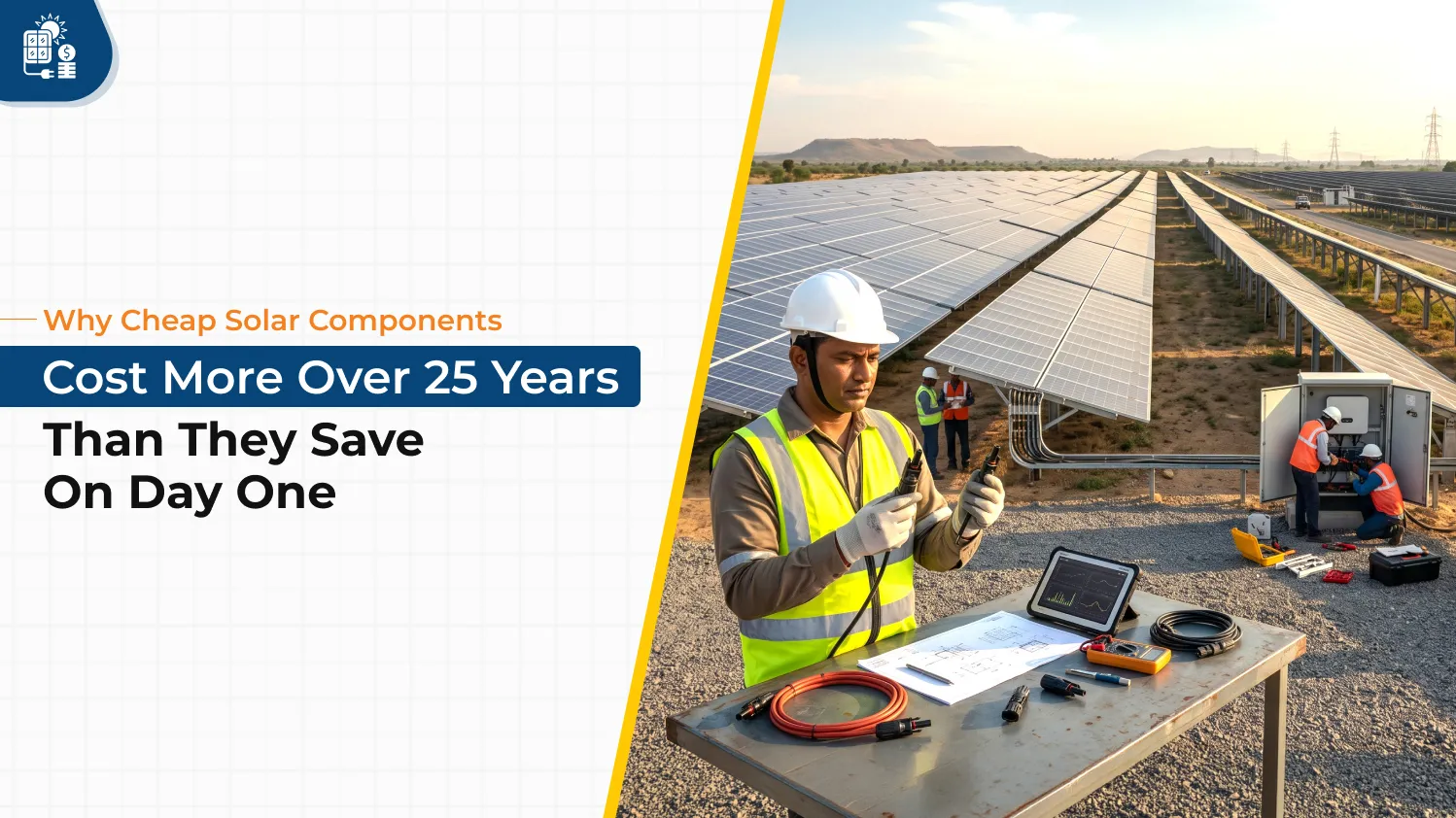
Every solar procurement decision starts with the same tempting comparison: two components that do roughly the same job, one significantly cheaper than the other. On a construction budget under pressure, the cheaper option looks like an easy win. What that comparison almost never accounts for is what happens to that component in year eight, or year fifteen, when it's the reason a string underperforms, an inverter needs early replacement, or a warranty claim gets denied over a component that was never properly certified in the first place.
Solar procurement services in Kutch exist because the gap between a component's purchase price and its actual lifetime cost is where a meaningful share of a solar plant's 25-year financial performance gets decided, often before construction has even begun.
The Procurement Decision Nobody Revisits Until It's a Problem
Procurement happens early, usually under schedule and budget pressure, and then it's essentially locked in for the plant's entire operating life. Nobody swaps out an underlying inverter model or panel manufacturer mid-project because a cheaper option turned out to have a higher failure rate. The decision made during sourcing is the decision the plant lives with for 25 years.
This is exactly why procurement deserves more scrutiny than it typically gets. A construction contractor evaluated on price and timeline has limited incentive to push back on a component substitution that lowers the bid but raises long-term risk. The pressure runs toward cheaper, faster, and good enough for commissioning, not toward what will still be performing reliably in year twenty.
Where Cheap Components Actually Cost More
The financial risk from low-cost components rarely shows up as a single dramatic failure. It shows up as a pattern of small, recurring costs that accumulate over years, each one individually explainable, collectively a meaningful drag on the plant's return.
Component Category | Cost-Cutting Risk | Long-Term Consequence |
Solar panels/modules | Lower-tier cells, inconsistent quality control | Faster degradation, output below warranted performance curve |
Inverters | Non-tier-1 manufacturers, limited local support | Higher failure rates, longer repair turnaround, costly replacements |
Cables and connectors | Undersized gauge, lower-grade insulation | Resistive losses, fire risk, accelerated wear in heat |
Mounting structures | Lower-grade coatings or steel | Faster corrosion, especially in humid or coastal conditions |
Combiner boxes and junction boxes | Non-weatherproof or poorly sealed enclosures | Moisture ingress, connection failures over time |
None of these show up as a defect at commissioning. Every component passes its initial test. The difference emerges gradually, in degradation rates, failure frequency, and maintenance costs that compound year over year in ways a day-one price comparison simply doesn't capture.
Panel Quality: The Difference Between a Warranty on Paper and a Warranty That Holds
Solar panels typically carry performance warranties stretching 25 years, guaranteeing output won't fall below a specified percentage of original capacity. That warranty is only as reliable as the manufacturer standing behind it and the consistency of the cells actually used in production.
Lower-tier manufacturers, or tier-1 manufacturers cutting corners on a specific product line, can produce panels that pass initial testing but degrade faster than their warranted curve suggests. When that happens years into operation, filing a successful warranty claim depends on the manufacturer still being in business, still honoring claims consistently, and the plant having documentation thorough enough to support the claim in the first place.
Effective solar panel procurement services in Kutch means evaluating manufacturers not just on cell efficiency and price, but on production consistency, financial stability, and track record of honoring warranty claims when panels do underperform. A panel that's five percent cheaper but degrades ten percent faster than warranted isn't a savings, it's a deferred cost with the bill arriving years later.
Inverters: Where Cheap Sourcing Creates the Most Recurring Cost
Inverters are typically the component most likely to require replacement or major repair during a plant's 25-year life, since they're more electronically complex than panels and operate under continuous thermal and electrical stress. This makes inverter sourcing one of the highest-leverage procurement decisions in the entire project.
A non-tier-1 inverter manufacturer with limited presence in India can offer a meaningfully lower price, but that price often comes with a longer wait for replacement parts, less technical support when something goes wrong, and a shorter effective lifespan under Kutch's high ambient temperatures. When an inverter fails and the replacement part has to be sourced internationally with a multi-week lead time, the lost generation during that downtime frequently exceeds whatever was saved on the original purchase.
What Solid Inverter Procurement Looks Like
Established manufacturers with proven local service networks and reasonable spare parts turnaround
Documented efficiency ratings under real operating temperature ranges, not just standard test conditions
A track record of honoring warranty and service commitments across other installed projects
Compatibility with the plant's monitoring infrastructure for early fault detection
Cabling and Electrical Components: Small Savings, Compounding Losses
Cable and connector costs represent a relatively small share of total project budget, which makes them an easy place to cut corners without the savings looking significant on a line-item basis. But undersized cabling and lower-grade connectors introduce resistive losses that reduce generation continuously, every single day the plant operates, and they degrade faster under the heat and humidity conditions common across parts of Kutch.
Corroded or loosened connectors don't just reduce output. They introduce a genuine fire risk, since increased resistance at a connection point generates heat that can escalate under sustained electrical load. This is one area where the cost of proper solar component procurement in Kutch is genuinely small relative to the risk it eliminates.
Mounting Structures: The Component Most Affected by Local Conditions
Mounting structure quality matters more in Kutch than in many other regions because coastal humidity in parts of the area accelerates corrosion significantly faster than in drier, inland climates. A mounting structure with inadequate galvanization or coating can begin showing structural degradation within a fraction of its expected lifespan, compromising panel alignment and, in more serious cases, structural integrity during high wind events.
Sourcing mounting hardware rated appropriately for local humidity and salt exposure, rather than a generic specification designed for a milder climate, is a decision that has almost no visible impact at commissioning and a very visible impact a decade later.
The Procurement Decisions That Actually Protect ROI
Good procurement isn't about always choosing the most expensive option available. It's about evaluating components against their expected performance and reliability over the plant's full operating life, not just their price at the time of purchase. A solar equipment sourcing company in Kutch built around this principle typically applies a consistent evaluation process across every major component category.
What Rigorous Procurement Evaluation Includes
Manufacturer track record and financial stability, since warranty claims decades from now depend on the manufacturer still honoring them
Component certifications and testing standards relevant to actual operating conditions, not just baseline compliance
Total cost of ownership modeling that accounts for expected failure rates, replacement costs, and lost generation during downtime
Local service and spare parts availability, which directly affects how quickly a fault gets resolved
Suitability for Kutch's specific environmental conditions, including heat, dust, and humidity where applicable
Comparing the Two Approaches Over a Plant's Lifetime
Factor | Cost-Minimized Procurement | Lifetime-Focused Procurement |
Initial construction budget | Lower | Moderately higher |
Component failure rate over 25 years | Higher, particularly for inverters and connectors | Lower, aligned with warranted performance |
Warranty claim success rate | Lower, often complicated by manufacturer instability or poor documentation | Higher, backed by established manufacturers and proper records |
Maintenance and replacement costs | Higher, recurring over the plant's operating life | Lower, more predictable |
Actual generation against financial model | Tends to drift below projections over time | Tends to track closer to original projections |
The gap in the first row is real and visible immediately. The gaps in every row below it are just as real, but they only become visible gradually, which is exactly why they're so easy to underweight during initial procurement decisions.
What to Ask a Procurement Partner Before Committing
For developers and asset owners evaluating solar procurement solutions in Kutch, a few questions help separate a partner focused on long-term plant value from one focused primarily on hitting a construction budget:
How are component manufacturers evaluated beyond price, and what track record data is reviewed?
Is total cost of ownership modeled against expected failure rates and downtime, or is procurement decided purely on upfront cost?
Are components sourced with Kutch's specific climate conditions factored into the evaluation?
What's the documented warranty claim success rate across other projects using the same component sourcing approach?
How is component documentation maintained to support warranty claims years into the plant's operation?
Vague answers here are usually a sign that procurement is being treated as a budget line item rather than a decision that shapes the plant's performance for the next 25 years.
Conclusion
The cheapest component available at the time of procurement is rarely the cheapest component over a plant's full operating life. Lower-tier panels, non-tier-1 inverters, undersized cabling, and inadequately rated mounting hardware all create costs that simply arrive later, in the form of faster degradation, more frequent failures, denied warranty claims, and generation that drifts below what the financial model promised. Procurement decided around 25-year performance, not just day-one price, is what protects a plant's return over the time horizon it was actually financed for.
White Desert Power Projects has handled procurement for organizations including Shriram Kaolin, GIPCL, Aditi Packaging, and Monex Solar Power LLP, sourcing components evaluated against long-term reliability and Kutch-specific conditions rather than upfront cost alone.
If you're planning a solar project and want procurement decisions made around 25 years of performance rather than the lowest quote, talk to White Desert Power Projects about a component sourcing approach built to protect your plant's long-term return.