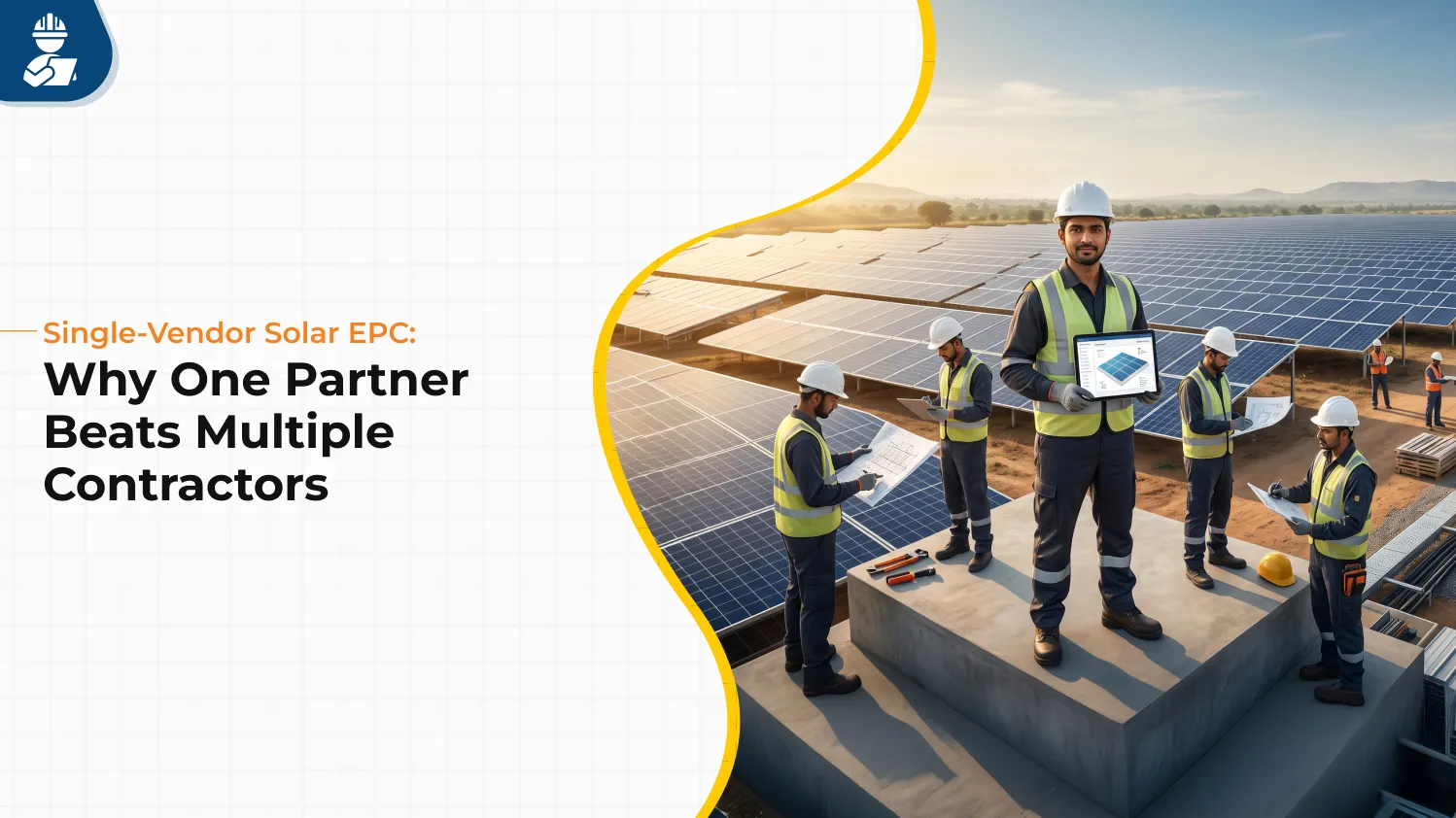
Every solar developer eventually faces the same decision early in a project. Hire a different specialist for each stage, a design consultant, a procurement agent, a construction contractor, a separate operations team, or bring the whole project under one accountable partner from planning through commissioning and beyond. It looks like a minor procurement choice on paper. In practice, it's one of the decisions that determines whether a MW-scale plant hits its financial targets or spends years quietly falling short of them.
Solar project development services in Kutch built around a single-vendor model exist because the fragmented approach, however cheaper it might look at the outset, tends to create exactly the kind of coordination gaps that cost far more over a plant's 25-year life than they ever saved during construction.
The Hidden Cost of Fragmented Execution
A multi-vendor project looks efficient on a spreadsheet. Each contractor bids competitively on their piece of the work, and the total looks lower than a bundled turnkey quote. What that comparison misses is what happens at every handoff between vendors, and there are more of those handoffs than most developers expect.
Design gets handed to procurement, which sources components based on a specification that may not fully reflect the site conditions the design team actually assessed. Procurement hands materials to a construction contractor, who builds according to drawings that weren't necessarily created with construction sequencing in mind. Construction hands the finished plant to an operations team, often for the first time at commissioning, expecting them to maintain a system they had no role in designing or building.
Each of these handoffs is a place where information gets lost, assumptions go unstated, and small compromises made under one team's schedule pressure become permanent limitations that the next team has to work around, usually without knowing why the compromise was made in the first place.
Where Fragmentation Actually Shows Up
Handoff Point | Common Failure | Long-Term Consequence |
Design to procurement | Component specs don't match site-specific design intent | Suboptimal equipment selection, reduced generation |
Procurement to construction | Materials arrive without construction sequencing in mind | Delays, on-site workarounds that compromise quality |
Construction to commissioning | Incomplete or inconsistent as-built documentation | Difficult troubleshooting later in plant's life |
Commissioning to operations | Operations team inherits a plant they didn't design or build | Slower fault diagnosis, warranty and maintenance gaps |
None of these failures are dramatic on their own. A slightly mismatched component spec doesn't sink a project. But four or five of these small gaps compounding across a plant's lifecycle is exactly how a well-financed project ends up underperforming its model year after year, without any single point in the process being clearly at fault.
What Single-Vendor Accountability Actually Solves
A solar EPC project development in Kutch approach built around one accountable partner doesn't eliminate every risk a project faces. Plants still develop faults, weather still causes delays, and components still fail occasionally regardless of how well a project is managed. What single-vendor accountability solves is something different: it removes the ambiguity about who is responsible for fixing a problem, and it means the team diagnosing an issue years into a plant's operation actually has access to the reasoning behind the original design decisions.
One Team, One Set of Assumptions
When design, procurement, construction, and long-term operations sit under one accountable partner, the assumptions made at the design stage carry through to every later decision. A structural choice made to account for local soil conditions doesn't get second-guessed by a construction contractor working from incomplete context. A maintenance access point built into the design during planning actually gets built, because the same organization responsible for long-term operations was involved in shaping that design decision from the start.
Faster Problem Resolution
When something goes wrong six months or six years after commissioning, a fragmented project structure often means the first several days are spent simply determining which vendor is responsible for the fix, and whether the issue falls under a warranty, a construction defect, or an operations lapse. A single accountable partner skips that step entirely. The same organization that built the plant is the one diagnosing and fixing the issue, with full access to the original design rationale and as-built documentation.
Documentation That Actually Holds Together
Warranty claims, lender reporting, and eventual resale or refinancing all depend on a plant's documented history being complete and consistent. Fragmented projects tend to produce fragmented documentation, each vendor keeping records in their own format, some of it lost entirely at the handoff points described above. A single-vendor approach to solar project planning and development in Kutch treats documentation as a continuous thread from initial site assessment through years of operational reporting, not a set of disconnected files assembled retroactively when a claim needs to be filed.
Solar Project Development Isn't Just Construction
It's worth separating two things that often get conflated: solar construction and solar project development. Construction is the physical build. Project development is everything that determines whether that build actually succeeds, site feasibility, permitting, grid interconnection strategy, financial structuring, and long-term operational planning, all worked out before a single foundation is poured.
A solar infrastructure development company in Kutch that treats project development as a distinct, upfront discipline rather than something that happens informally alongside construction tends to avoid the kind of late-stage surprises that derail timelines and budgets. Site feasibility studies that account for grid capacity constraints, environmental clearances that are secured before construction schedules are finalized, and financial models that are stress-tested against realistic generation assumptions all belong in this development phase, not discovered as problems partway through a build.
What Proper Project Development Covers
Site assessment and feasibility - evaluating land suitability, irradiance data, grid proximity, and environmental factors specific to the site
Regulatory and permitting strategy - securing the approvals and clearances needed before construction begins, sequenced to avoid delays later
Grid interconnection planning - assessing substation capacity, curtailment risk, and interconnection queue timelines specific to the region
Financial structuring - building a realistic generation and revenue model that construction and operations decisions get measured against
Design that anticipates operations - incorporating maintenance access, monitoring infrastructure, and long-term serviceability into the design from the outset
Skipping or rushing any of these steps tends to surface later as a construction delay, a grid connection problem, or a plant that was built to a design that never quite matched its financial assumptions.
Why This Matters More at Utility Scale
The case for single-vendor accountability strengthens as project size increases. A small rooftop system has relatively few components and a short construction timeline, so the coordination risk of using multiple vendors is limited. A MW-scale ground-mount project involves hundreds of strings, multiple inverters, substation-level grid interconnection, and a construction timeline stretching months, all of which multiply the number of handoff points where fragmentation can introduce problems.
Effective solar project management services in Kutch for utility-scale projects means coordinating civil work, electrical installation, grid interconnection testing, and commissioning as a single continuous process, with the same team tracking the project from initial planning through the operations phase that follows. This isn't just an efficiency preference, it's what determines whether a plant meets its commissioning timeline and its projected output once operational.
Scale Changes the Stakes, Not the Principle
Project Scale | Coordination Complexity | Cost of Fragmentation |
Residential rooftop | Low, few vendors involved, short timeline | Minor, usually limited to installation quality issues |
Commercial rooftop or small ground-mount | Moderate, multiple trades and equipment types | Meaningful, affects both timeline and long-term performance |
Utility-scale ground-mount | High, hundreds of components, grid interconnection, multi-month build | Significant, directly affects financial model and long-term revenue |
The principle holds at every scale. It simply becomes more expensive to ignore as the project gets larger.
Solar Energy Project Management as a Continuous Discipline
Project management in solar development doesn't end at commissioning. Solar energy project management in Kutch that's structured for long-term performance treats the transition from construction to operations as a planned handover within the same organization, not a final deliverable passed to an external maintenance vendor with no prior involvement in the build.
This continuity matters most in the years after commissioning, when a plant's actual performance either tracks its financial model or gradually drifts from it. A project management approach that stays involved through operations means underperformance gets caught against the original design assumptions, not just against a generic industry benchmark that may not reflect the plant's specific site conditions.
Choosing Between a Fragmented and a Single-Vendor Approach
For developers weighing the decision, a few questions tend to clarify which approach actually fits a given project:
Does the organization handle design, procurement, construction, and operations under one accountable team, or subcontract each stage separately with no shared oversight?
Is documentation maintained continuously from site assessment through years of operation, or assembled retroactively at each stage?
Who is responsible for diagnosing and resolving an issue that develops after commissioning, and how quickly can that responsibility be established?
Does the design process account for long-term maintenance access and monitoring infrastructure, or is that added as an afterthought during construction?
Can the provider show a track record of plants they've supported continuously from planning through years of operation, not just construction?
A solar power plant development in Kutch partner that can answer these clearly, with a consistent team and documented history across a project's full lifecycle, tends to be the one whose plants hold up against their original financial projections a decade or more into operation.
Conclusion
A lower construction bid from a fragmented set of vendors can look appealing at the outset of a project, but the real cost of that approach shows up later, in delayed fault diagnosis, inconsistent documentation, and a plant whose actual performance gradually drifts from what it was designed to deliver. Single-vendor accountability doesn't eliminate every risk a solar project faces, but it removes the ambiguity and information loss that fragmented execution almost always introduces.
White Desert Power Projects has worked with organizations including Shriram Kaolin, GIPCL, Aditi Packaging, and Monex Solar Power LLP, delivering solar project development and execution under a single accountable team from initial site assessment through years of long-term operations.
If you're evaluating how to structure your next solar project, it's worth comparing a fragmented multi-vendor approach against a single-partner model before committing. Talk to White Desert Power Projects about a turnkey development approach built around long-term accountability, not just a competitive construction quote.