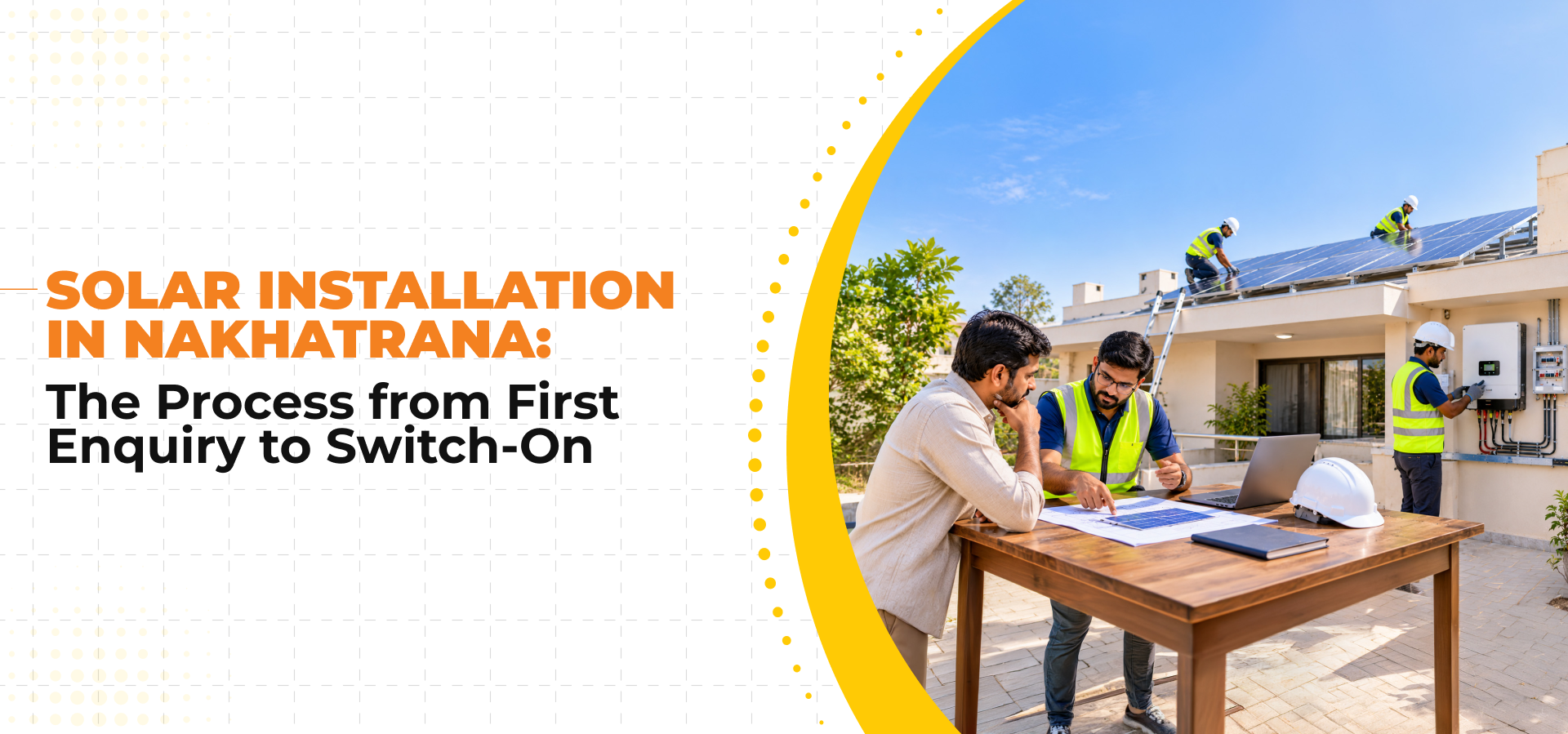
Most people looking into solar in Nakhatrana already know why they want it: lower bills and power that holds up when the grid wobbles. What's less clear is the route between the first phone call and the day the net meter goes live. This guide walks through that route in order. It uses the seven-stage process White Desert Power Projects follows from its office on the Bhuj–Nakhatrana Highway, along with the Gujarat and PGVCL rules that apply to every installer.
How does solar installation work from first enquiry to switch-on?
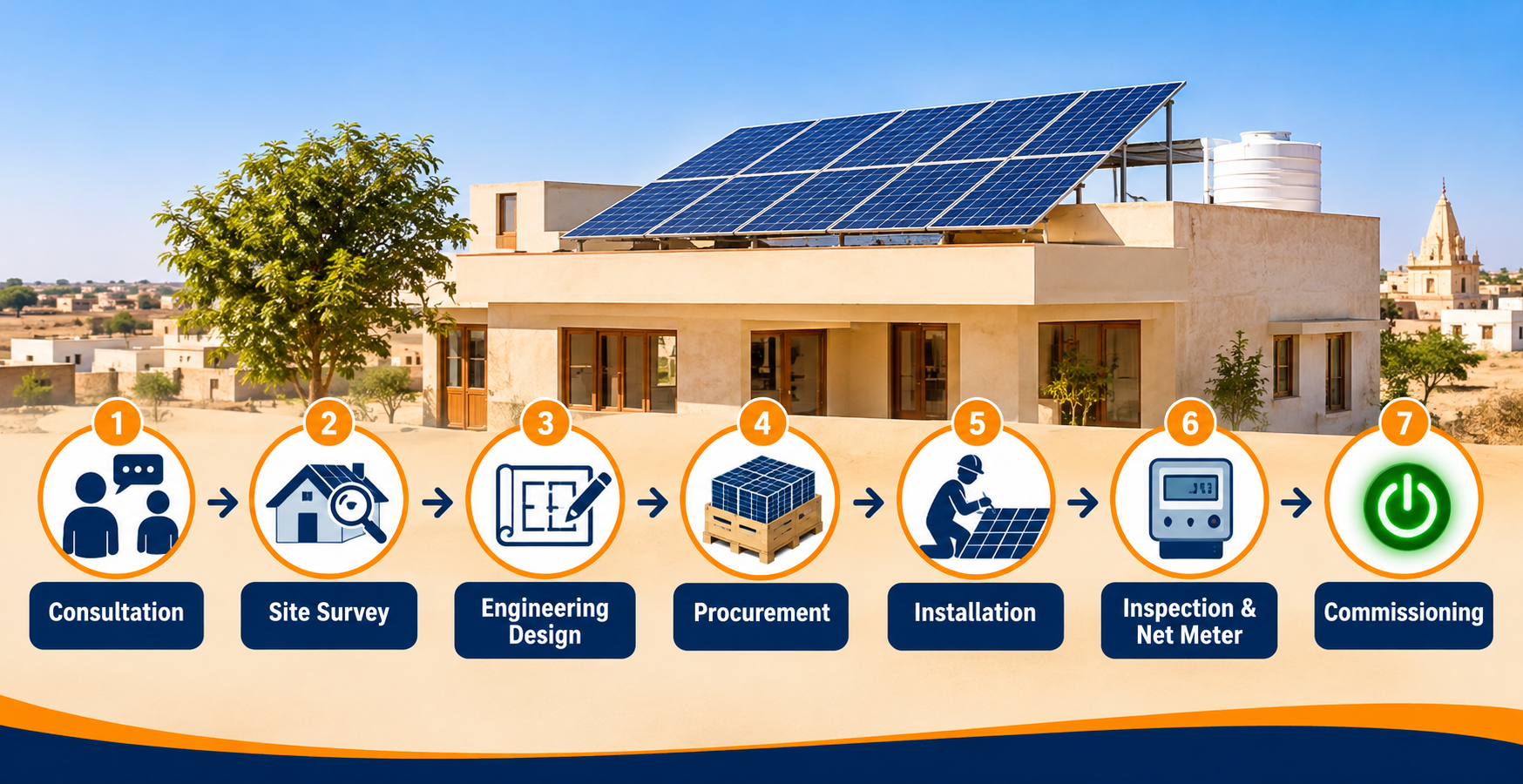
Short answer: A grid-connected system moves through consultation, site survey, engineering design, procurement, installation, DISCOM inspection with net metering, and commissioning. Physical installation is the shortest part (1–3 days for a typical home system). Most of the calendar time goes to approvals, inspection and meter installation.
Stage | What happens | Typical time |
1. Consultation | Review bills, load, roof or land, budget | Varies by site |
2. Site survey | Shading, structure, yield estimate | Varies by site |
3. Engineering design | System sizing, single-line diagram, layouts | Varies by site |
4. Procurement | Panels, inverters, mounting, cables | Depends on stock and lead times |
5. Installation | Structure, panels, wiring, earthing | 1–3 days (home systems) |
6. Inspection & net meter | PGVCL checks, bidirectional meter installed | 7–20 days after installation |
7. Commissioning | Certificate issued, system goes live | Around 3 days after inspection |
Across the full cycle, third-party sources put PGVCL home systems at roughly 35–50 days from application to commissioning. White Desert's published timelines are 30–60 days for commercial rooftop projects (50 kW–1 MW) and 90–180 days for 1–10 MW ground-mounted plants. Treat these as planning ranges, not guarantees. Feasibility checks, equipment availability and inspector schedules all move the dates.
Step 1: What should you prepare before the first enquiry?
Bring your latest electricity bill, your consumer number, and a rough idea of when your power use peaks. For anyone comparing options for solar installation in Nakhatrana, these three items let an engineer size a system correctly on the first visit.
For a home applying under PM Surya Ghar, the document list is short:
Latest PGVCL electricity bill, with the name matching your other documents
Aadhaar linked to an active mobile number (used for OTP verification)
PAN card
Bank passbook or cancelled cheque, in the same name as the application
Roof ownership proof such as a sale deed or house tax receipt
A passport-size photograph
If the connection is in a parent's or family member's name, expect to need a name transfer or an authorisation affidavit. Name mismatches between Aadhaar, the bill and the bank account are one of the most common causes of subsidy delay.
Step 2: What happens at the site survey and design stage?
The survey converts your bill into a real system size. Engineers check how much usable, shadow-free roof you have (a rough rule is about 100 sq. ft. per kW), the condition of the slab, the position of water tanks and parapets, and the route for cables to your meter.
On a good site, one kW generates roughly 1,500–1,650 units a year in Kutch and Gujarat, based on about 5.5–6.2 peak sun hours a day. The design stage turns this into a single-line diagram, a panel layout and a structural plan. These drawings go into the application, so quality here prevents rework later.
What does a solar EPC company actually do?
EPC stands for Engineering, Procurement and Construction. One company handles design, sourcing of components, installation and the paperwork up to commissioning, which means one party is accountable if something goes wrong. A buyer searching for the best solar EPC company in Nakhatrana is really asking who will carry the whole job without handing critical work to subcontractors. White Desert states that it keeps critical work with in-house crews and also covers financing and subsidy assistance and long-term operations and maintenance.
Which route applies to you: residential, commercial or industrial?
The process is the same in outline, but the approvals, subsidies and system sizes differ.
Residential | Commercial | Industrial | |
Typical user | Homes | Shops, offices, workshops, hotels | Factories, cold storage, processing units |
Central subsidy | Yes, PM Surya Ghar | No direct subsidy | No direct subsidy |
Tax benefit | Not applicable | 40% accelerated depreciation | 40% accelerated depreciation |
DISCOM route | PM Surya Ghar portal / PGVCL | Net metering via PGVCL | Net metering, or open access / captive for larger loads |
Inspection | Simplified DISCOM workflow | CEIG sign-off for larger systems | CEIG sign-off |
Residential solar in Nakhatrana almost always runs through the PM Surya Ghar portal. You register with your PGVCL consumer number, upload documents, choose an empanelled vendor and wait for feasibility approval, which is generally treated as deemed for systems up to 10 kW.
For shops, workshops and offices, commercial solar in Nakhatrana is usually a self-consumption project. The savings come from offsetting daytime tariffs, and the 40% accelerated depreciation can lower the effective cost for a business. Your accountant should confirm how it applies in your case.
Industrial solar in Nakhatrana is a different scale of project. Cold storage, processing units and workshops have loads that line up with daylight hours, and larger consumers can look at captive or open-access routes. White Desert's published portfolio in Kutch includes a 1 MW ground-mounted plant, a 3 MW project and a 300 MW utility-scale park. It also states that industrial clients typically see payback between 3.5 and 5 years. Your own result depends on tariff, load and site.
What subsidies are available in 2026?
Central subsidy (PM Surya Ghar: Muft Bijli Yojana). For homes with a domestic connection:
System size | Central subsidy |
1 kW | ₹30,000 |
2 kW | ₹60,000 |
3 kW and above | ₹78,000 (maximum) |
The subsidy is paid by Direct Benefit Transfer after commissioning. You log in to the portal, submit bank details, and redeem the e-token. Official guidance says credit typically follows within about 30 days. In practice, Gujarat installations are often reported at around 6–8 weeks end to end. If you take a scheme loan, the subsidy first goes to the loan account.
Key conditions: the connection must be residential, in the applicant's name, and you must not have claimed a previous rooftop subsidy. Tenants need a no-objection certificate from the owner. Panels must meet domestic content (DCR) requirements, which is why subsidised systems use Indian-made cells and modules.
New Gujarat state top-up (October 2026). Gujarat has approved additional state support for residential systems up to 2.18 kWp, for systems commissioned on or after 22 October 2026. The benchmark cost is ₹50,000 per kW for the first 2 kW and ₹45,000 per kW beyond that. The household contributes 10% of the benchmark cost (5% for SC/ST households), and the state covers the remainder after central assistance. Anyone taking it cannot add further rooftop capacity for three years. PGVCL consumers are covered, with GUVNL as the nodal agency. Ask for the exact payable amount in writing before you sign, because it depends on your system size and category.
Farmers. PM-KUSUM supports solar pumps and ground-mounted plants for agricultural use.
How much does solar cost in and around Nakhatrana?
Prices below are indicative Gujarat ranges, not quotes.
System | Indicative cost |
3 kW home system (before subsidy) | ₹1,50,000–₹1,80,000 |
Same, after ₹78,000 central subsidy | About ₹72,000–₹1,02,000 |
25 kW commercial | ₹45,000–₹55,000 per kW |
100 kW commercial | ₹40,000–₹48,000 per kW |
500 kW | ₹36,000–₹42,000 per kW |
1 MW and above | ₹35,000–₹42,000 per kW |
A 3 kW system generates roughly 400–450 units a month by third-party estimates. Quoted payback ranges from about 2.5 to 5 years depending on tariff, subsidy and system size, so the number you're offered should come with the assumptions behind it. For systems above 10 kW, ask your installer to confirm whether any grid support charges apply, as Gujarat has introduced charges for larger systems and they affect long-term returns.

What makes installation in Kutch different?
Wind and earthquakes. Kutch has one of the highest design wind speeds in India and sits in the highest seismic zone. Because rooftop solar in Nakhatrana must be engineered for strong gusts and ground movement, mounting structures need proper anchoring into a sound slab instead of loose ballast. Larger systems may require a structural stability certificate from a licensed engineer, so ask your installer which applies to you.
Dust and heat. The region is dry and dusty. A film of dust can cut output noticeably, and in places closer to the coast, salt in the air adds to the film and can speed up corrosion of frames and fasteners. Specify corrosion-resistant mounting and connectors.
Grid reliability. A standard on-grid system shuts down during a power cut. This is the anti-islanding safety feature, and it applies even when the sun is shining. Voltage fluctuations can also trip an inverter repeatedly and reduce generation. Choose an inverter rated for a wide voltage range.
System type | Works in a blackout? | Net metering | Relative cost |
On-grid | No | Yes | Lowest |
Hybrid (with battery) | Yes, for chosen loads | Yes, subject to DISCOM approval | Typically 40–60% higher |
Off-grid | Yes | No | Highest |
Where outages are frequent, or for loads such as irrigation pumps and cold storage, hybrid systems with LiFePO4 batteries are worth pricing. They handle heat better than lead-acid batteries. Batteries are generally not covered by the central subsidy, so budget for them separately. On-grid is usually the better-value choice where the grid is stable.
How do inspection, net metering and commissioning work?
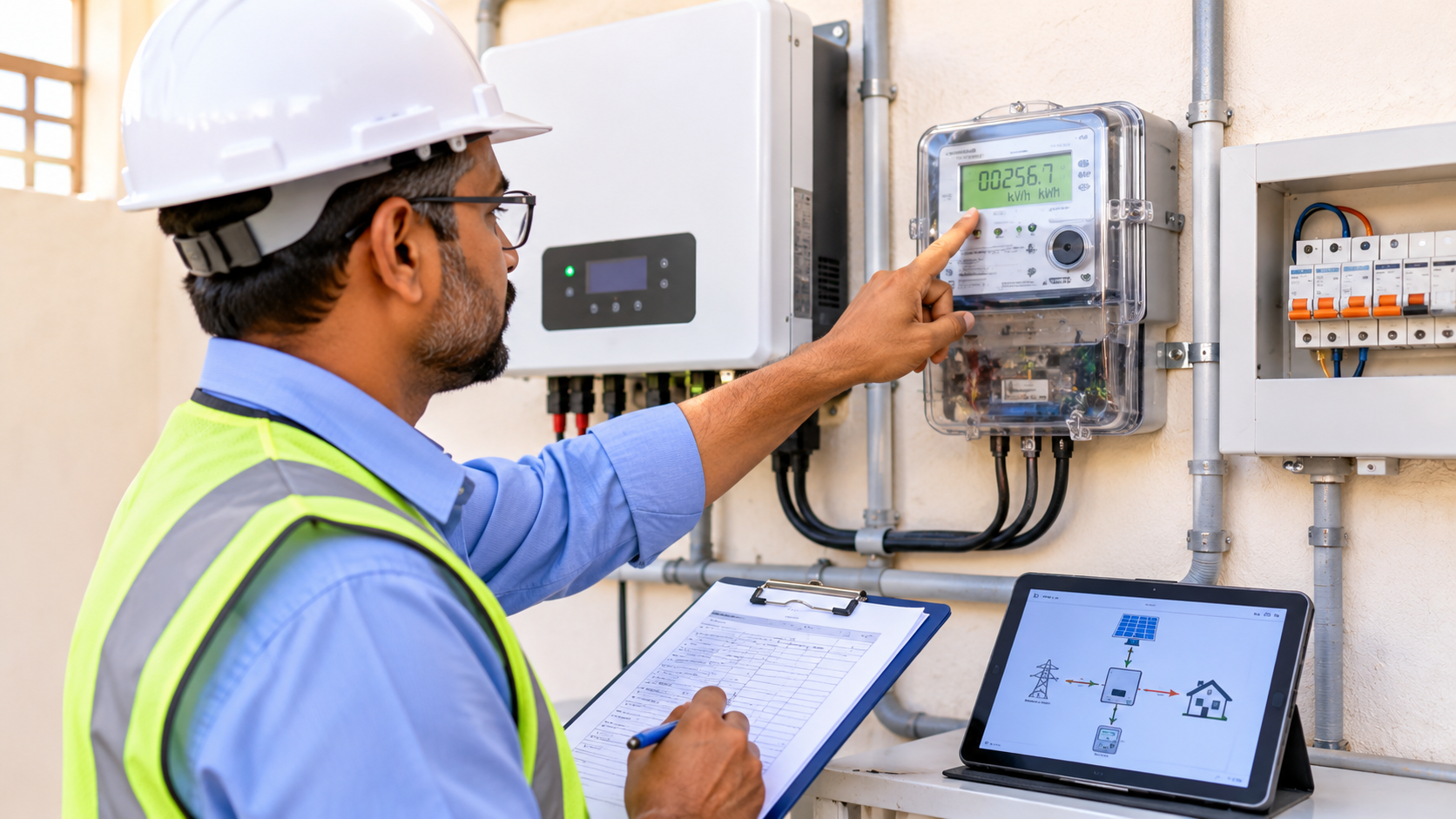
Once installation is complete, your installer uploads the completion report, single-line diagram and geo-tagged photographs to the portal. PGVCL engineers then inspect earthing, wiring and anti-islanding protection and install a bidirectional meter. Expect roughly 7–20 days for this stage under PGVCL. The commissioning certificate follows shortly after.
Under GERC net metering, your meter records both the energy you import and the energy you export. Within each billing cycle, exports are set off against imports. If imports exceed exports, you're billed for the net units. If exports exceed imports, the surplus is compensated at a rate fixed under GERC rules, so confirm the current rate with your installer. Any power exported before the meter is installed and commissioning is complete earns no credit, so don't switch on early.
Commercial and larger systems need Chief Electrical Inspector (CEIG) clearance before charging. Smaller residential systems follow a simplified DISCOM workflow.
What happens after switch-on?
Commissioning is the start of the system's working life, not the end of the project. Three things matter afterwards.
Subsidy follow-through. Log in, submit bank details and redeem the e-token. Missing this step is one of the commonest reasons residential subsidies are delayed.
Cleaning. Any solar panel in Nakhatrana will collect dust, so plan on regular washing, more often in the dry summer months and after dust storms. Clean early in the morning or after sunset, use a soft brush or microfibre mop with clean water, and avoid high-pressure jets that can damage seals. Hard borewell water can leave mineral marks.
Monitoring and support. Generation data tells you quickly when something is wrong. White Desert offers 24×7 remote monitoring with preventive cleaning and fault resolution, and states a 95%+ plant availability guarantee in its O&M contracts. Whoever you choose, find out what's in writing. People who judge the best solar service in Nakhatrana by what happens in year three, not just at handover, tend to choose better.
How do you choose an installer in Nakhatrana?
Start with verification, because it's free and protects your subsidy.
If you're trying to find the best solar company in Nakhatrana, begin with the PM Surya Ghar portal. Open it by typing the official address yourself rather than following a forwarded link. Check the registered vendor list for your state and DISCOM, search the exact legal company name, and confirm that the status is active. Empanelment is DISCOM-specific, so an approval elsewhere doesn't cover PGVCL areas.
Any solar company in Nakhatrana should be able to name the panel and inverter makes, show DCR and ALMM documentation, and give a written scope covering net-metering paperwork.
Watch for red flags:
Claims that MNRE has "certified" or "recommended" a particular company
"Empanelment in process"
Large upfront cash payments outside the official process
Extra "subsidy processing fees"
For roof systems, the best solar rooftop company in Nakhatrana is the one that can show structural and wind-load thinking for Kutch conditions, not only a price per kW.
Ask for these items in writing from every installer you shortlist:
Panel make, wattage, DCR status and warranty (panels commonly carry a 10–15 year product warranty and a performance warranty of about 25 years)
Inverter make and warranty (typically 5–10 years)
Mounting material, wind and seismic design basis
Who files the net-metering application, and the expected dates
What the maintenance obligation covers after commissioning (the scheme expects vendor support for five years on subsidised systems)
Where do White Desert Power Projects fit?
White Desert is a solar EPC company with an office at R.N. Complex on the Bhuj–Nakhatrana Highway. Its website describes MNRE empanelment, in-house crews, a seven-stage process that matches the one above, and services from financing and subsidy assistance through to O&M. Its published projects are in Kutch, including a 1 MW ground-mounted plant, a 3 MW project and a 300 MW renewable energy park at Khavda.
As with any installer, you should verify empanelment yourself on the official portal. Any top solar company in Nakhatrana should welcome that check. The consultation is free to request, and a site visit is the fastest way to turn this article's ranges into a quote for your own roof.