

Searching for the best solar company in Anjar usually ends in a pile of near-identical quotes. The price per kilowatt looks similar and every installer promises savings. Few explain what separates a system that performs for 25 years from one that disappoints in year three. This guide gives you the questions, documents and checks that do separate them. It also covers Kutch-specific context: subsidy rules, PGVCL net metering, dust, salt and wind, and how businesses should think differently from homeowners.
White Desert Power Projects is a solar EPC firm working across Kutch, and we've written this so you can test us as hard as any other installer. We won't name a "best" installer, because that depends on your roof, your load and your paperwork. We will show you how to find out for yourself.
How Do You Choose a Solar Installer in Anjar?
Short answer: Check documents, not claims. Confirm the installer is verifiably empanelled for your DISCOM, names exact equipment in writing, surveys your roof in person, designs for Kutch conditions, handles PGVCL and subsidy paperwork, and ties payments to milestones.
Any solar company in Anjar worth hiring should be able to answer the points below in writing before you pay an advance.
Check | What good looks like | Red flag |
Empanelment | Active listing on the PM Surya Ghar portal for your district and DISCOM; legal name matches the quote | "Approval in process", no registration ID |
Equipment | Exact make, model and wattage of panels and inverter in the contract; panels on the ALMM list | Generic "Tier-1" labels |
Site survey | Physical visit covering shading, roof structure and sanctioned load | Remote quote with no visit |
Itemised quote | Equipment, structure, labour, permits and DISCOM application listed separately | One lump-sum figure |
Payments | Milestone-based (advance, material delivery, installation) | 100% upfront demand |
Warranties | Separate documents for panels, inverter and workmanship | One vague "25-year warranty" |
Paperwork | Installer manages subsidy, net metering and commissioning | You are sent between offices yourself |
Local design | Structure engineered for wind, salt and dust, with cleaning access | Standard inland design |
Be wary of any "zero electricity bill" promise made without seeing your bills. You will always pay fixed charges to the DISCOM.
Someone asking for the best solar rooftop company in Anjar is really asking who will survey properly, specify honestly and stay reachable after commissioning. Those traits show up in the checklist above, not in a ranking.
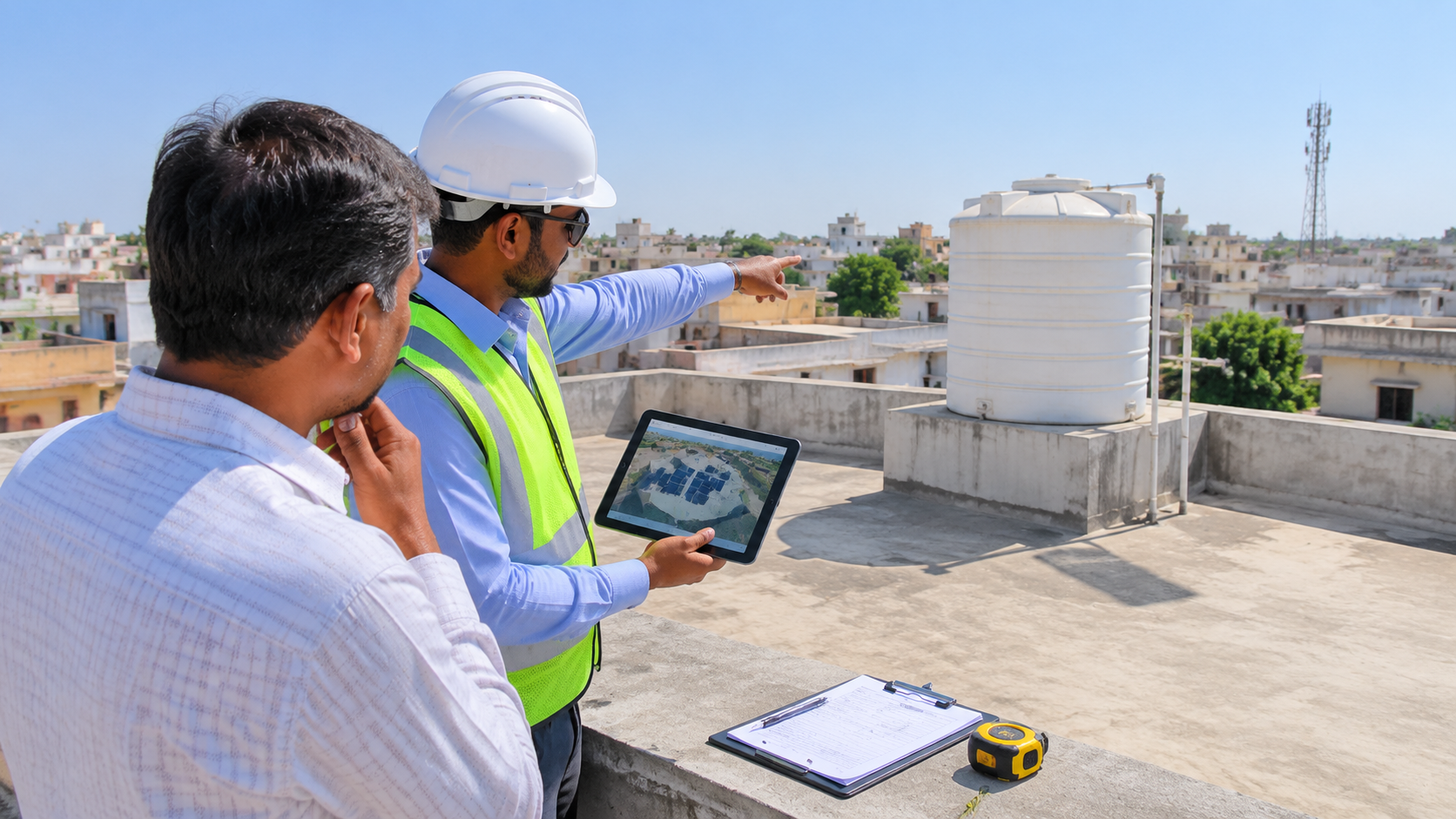
How Can You Verify an Installer for PM Surya Ghar?
Subsidy depends on using the right vendor and the right equipment, so verify before you sign:
Type pmsuryaghar.gov.in into your browser yourself rather than clicking a link from a message or advert.
Open the vendor list and filter by state, your DISCOM exactly as printed on your bill, and your district. Empanelment is DISCOM-specific, so a vendor listed elsewhere is not automatically authorised for your job.
Search the exact registered legal name, not the brand name, and confirm the status is active.
Ask for the exact panel model and cross-check it against the MNRE ALMM List-I. Panels must be ALMM-listed and domestic-content compliant, or you can lose the subsidy.
Check that the inverter meets the relevant BIS standards.
Make sure your name, address and ID details match across your Aadhaar, electricity bill and bank account, because mismatches are a common reason for rejection. Do the same checks on us. Ask White Desert for registration details and equipment datasheets, as you would with anyone.
Is a Solar EPC Company Better Than a Local Dealer?
A solar EPC company handles engineering, procurement and construction under one contract. A dealer mainly sells hardware, and installation may be subcontracted.
If your search is for the best solar epc company in Anjar, the distinction matters most for larger or more complex projects, where design, procurement and construction are separate disciplines.
Factor | Solar EPC company | Local dealer |
Focus | A commissioned, working plant | Selling panels, inverters, kits |
Design | In-house engineering | Often basic or outsourced |
Installation | Own crews | Frequently subcontracted |
Accountability | One point of contact | Split between manufacturer, dealer and installer |
Paperwork | DISCOM and subsidy handled end to end | May fall to you |
Best for | Commercial, industrial, complex homes | Small, simple jobs |
A dealer can be a sensible choice for a small, straightforward job. What matters is knowing which model you are buying.
What Does Residential Rooftop Solar Cost After Subsidy?
Residential solar in Anjar is priced like the rest of Gujarat, with local variation from roof type, structure design and site access. Published 2026 statewide ranges look like this:
System size | Cost before subsidy | Central subsidy | Net cost |
3 kW | ₹1,50,000–₹2,15,000 | ₹78,000 | ₹72,000–₹1,37,000 |
5 kW | ₹2,50,000–₹3,30,000 | ₹78,000 | ₹1,72,000–₹2,52,000 |
10 kW | ₹5,10,000–₹5,74,000 | ₹78,000 | ₹4,32,000–₹4,96,000 |
These are indicative ranges from published market sources, not White Desert quotes. Your final price depends on the survey.
How is the central subsidy calculated? PM Surya Ghar gives ₹30,000 per kW for the first 2 kW and ₹18,000 for the third kW. That is ₹30,000 for 1 kW, ₹60,000 for 2 kW and a maximum of ₹78,000 for 3 kW and above.
Is there a Gujarat top-up? The Gujarat government approved an additional state subsidy on 22 October 2026. As reported, the main terms are:
It applies to residential systems up to 2.18 kWp commissioned on or after 22 October 2026.
The household contributes 10% of a benchmark cost (5% for SC and ST households).
The benchmark is ₹50,000 per kW for the first 2 kW and ₹45,000 per kW beyond that.
No further rooftop capacity can be added for three years.
Payment is by direct bank transfer through the DISCOMs, including PGVCL.
Because the scheme is only days old, confirm with your installer and the portal how it combines with the central subsidy, and what you would pay out of pocket, before fixing your system size. The state top-up stops at 2.18 kWp while the central subsidy tops out at 3 kW. Choose your size by your consumption and roof, not by whichever subsidy looks bigger.
Who is eligible? The rules are:
You own a residential property, or you are a tenant with a signed no-objection certificate from the owner.
You have an active domestic electricity connection in your name.
Your sanctioned load can support the proposed capacity.
You have no existing rooftop solar and have not taken a central solar subsidy before.
There is no income limit.
You have an Aadhaar-linked mobile number and bank account.
How much will it generate and save? A 1 kW system in Kutch generates roughly 1,500 to 1,800 units a year, or about 4.5 to 5.3 units a day, though actual output varies with orientation, shading and cleaning. PGVCL urban domestic slabs run from about ₹3.05 per unit for the first 50 units to about ₹5.20 above 250 units, plus fuel adjustment charges and electricity duty. Check your own bill, since rates change. Cutting consumption removes the top slabs first, so households with higher usage tend to see larger per-unit savings.
How much roof do you need? About 80 to 100 sq ft of shadow-free space per kW, on a roof that can carry roughly 15 to 20 kg per square metre including mounting.
How Do Dust, Salt, Heat and Wind in Kutch Affect Your System?
Kutch has strong sunshine, but the same environment is hard on equipment. Typical irradiance is around 5.5 to 6.5 kWh/m²/day. It is highest in March to May, dips in the monsoon and is lower in winter, though skies stay mostly clear.
Dust: A moderate layer can cut output by 5–15%, and heavy build-up by 20–25% or more.
Salt: Coastal air leaves a sticky film that can reduce light transmission by roughly 3–6%. Light rain does not remove it.
Heat: Panels can run at 60–70°C, and efficiency falls about 0.3% for each degree above 25°C.
How often should panels be cleaned? Every 14 to 28 days is the common guidance for dusty, coastal regions, and more often in peak summer. Clean early morning or evening and never pour cold water on a hot panel. Use plain water and a soft cloth, not pressure washers or harsh chemicals.
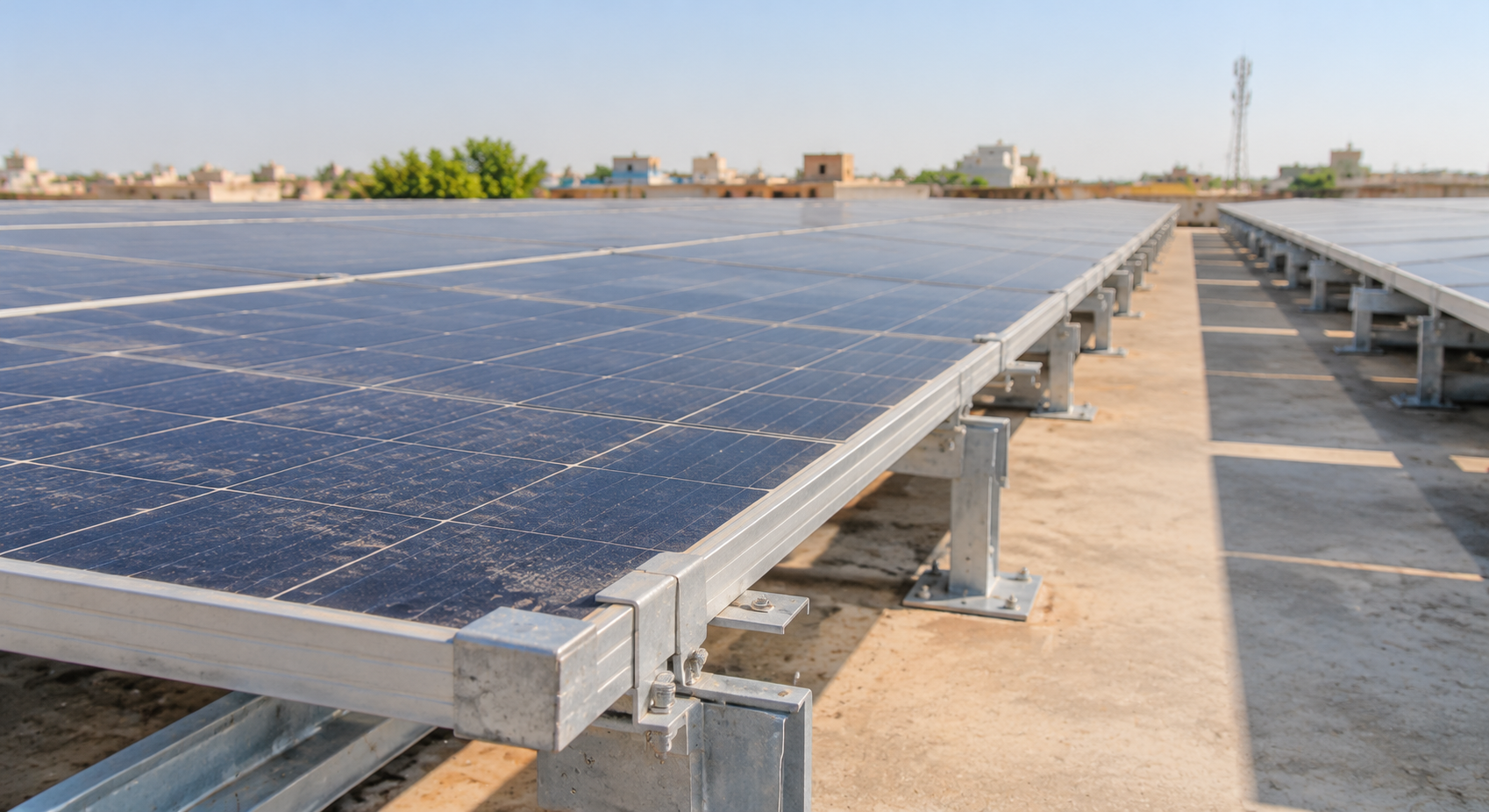
For any solar installation Anjar, Gandhidham or Bhachau customers commission, the structure matters as much as the panels. Guidance for Kutch conditions points to:
Dual-glass modules with a certified load rating of at least 5,400 Pa and IEC 61701 salt-mist certification.
Structures designed for a basic wind speed of 50 m/s under IS 875, with heavy hot-dip galvanisation (guidance cites around 120 microns).
Stainless steel 304 or 316 fasteners.
A low tilt of about 10–15° to reduce wind uplift.
Proper anchoring into the slab. Parts of Kutch also fall under Seismic Zone V.
These are published guidance figures. Your installer's structural engineer should confirm the design for your building.
What Are the Steps and Timeline for PGVCL Net Metering?
Rooftop solar in Anjar connects to the grid through PGVCL, the DISCOM for Kutch. Your panels power the home first, and surplus is exported through a bi-directional meter. Your bill is then based on net units. Surplus left over can be settled at GERC-approved rates, reported at around ₹2.25 per unit.
Stage | Typical time |
Online application and feasibility (up to 10 kW is deemed feasible) | 7–15 working days |
GEDA / SURYA Gujarat registration | About 5 days |
Drawing (SLD) approval | About 10 days |
Installation on a typical home | 1–3 days |
Net meter fitted after clearance | About 5 days |
Joint inspection and commissioning certificate | About 3 days |
Subsidy credit by bank transfer | Within 30 working days of the certificate; often 6–8 weeks end to end |
Overall, 30 to 60 days from application to commissioning is typical in Gujarat, with stages overlapping. Your installer should help you gather:
Your latest bill showing the consumer number and sanctioned load.
A photo ID.
Ownership proof or the owner's no-objection certificate.
The single-line diagram, panel and inverter datasheets and certificates, and the roof layout.
The installer's electrical contractor licence number.
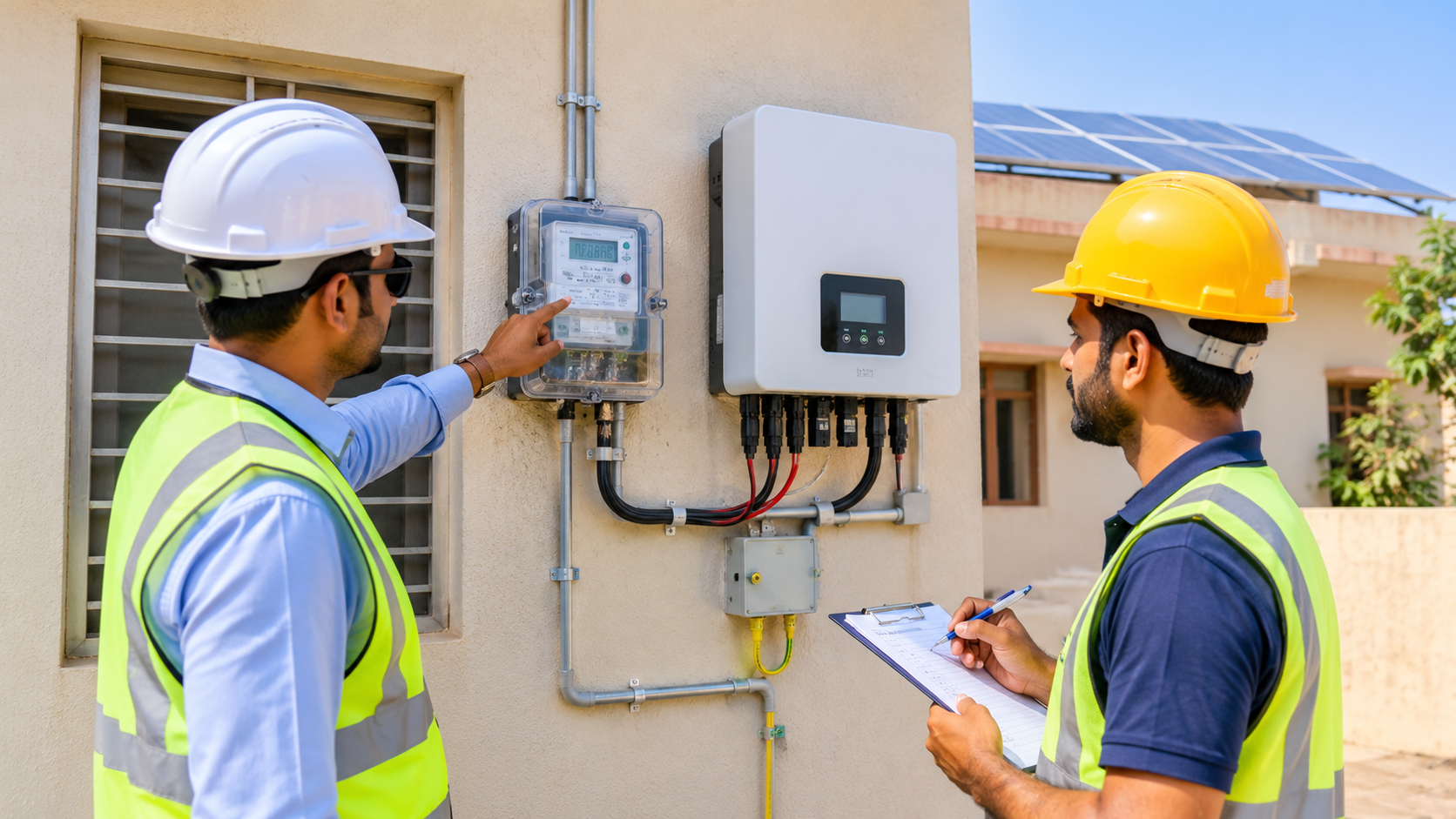
Will it work during a power cut? A standard on-grid system shuts down when the grid fails, as an anti-islanding safety feature. If you have frequent outages (around five hours or more a month) or must keep essentials running, ask for a hybrid system with a battery. For a stable grid where the goal is lower bills, on-grid is the lower-cost route.
How Should Shops, Offices and Institutions Approach Solar?
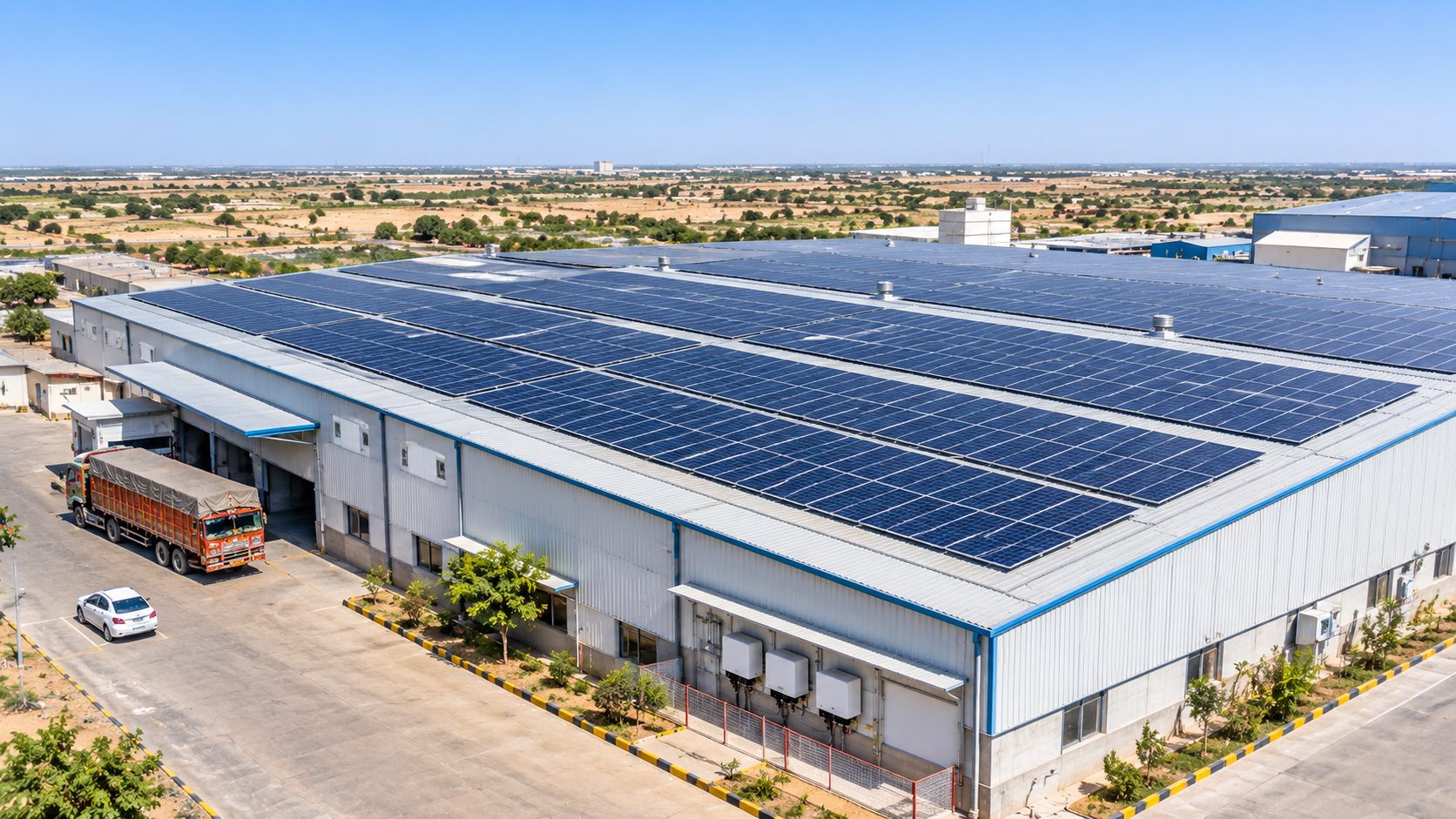
Commercial solar in Anjar suits businesses with strong daytime consumption, such as shops, clinics, schools, warehouses and hotels. Low-tension commercial energy charges are around ₹4.35 to ₹4.65 per unit in published tariff summaries. Fuel adjustment charges and electricity duty (reported at 20–25% for commercial connections) push the effective cost higher, so your own bill is the real benchmark.
Published 2026 cost ranges for Gujarat:
50–200 kW: about ₹48,000–₹58,000 per kW.
200–500 kW: about ₹41,000–₹54,000 per kW.
Key rules to confirm early:
Item | What applies |
Capacity cap | Generally up to 50% of sanctioned load or contract demand; MSME manufacturers can go higher |
Connection | Low tension up to 150 kVA contracted demand; HT above |
Grid headroom | Local transformer capacity can limit approvals |
CEIG inspection | Not required below 10 kWp; typically exempt 10–100 kWp; mandatory above 100 kWp |
On tax, solar generation systems qualify for 40% written-down-value depreciation, with an additional first-year depreciation possible under conditions that depend on your tax regime, so speak to your chartered accountant. GST is 5% on modules and inverters and 18% on structures, with turnkey contracts working out around 8.9% effective. GST-registered businesses can claim input tax credit. General market estimates put payback at roughly 3 to 5 years, depending on tariff and daytime load.
What Should Industrial Users Know About Solar and Grid Access?
Industrial solar in Anjar is shaped by high-tension tariffs and daytime process loads, with the nearby industrial belt around Gandhidham and Mundra shaping demand. Published summaries put the effective HT cost at roughly ₹7.50 to ₹8.50 per unit once demand, wheeling and surcharges are included, so factories that run heavy daytime loads can use most of what they generate.
Route | Where the plant sits | Typical scale | Key point |
Net metering | On your own roof or premises | 1 kW to 1 MW | No wheeling charges |
Group net metering | One host site, offsetting several connections | Within DISCOM rules | Same entity, same DISCOM |
Open access | Off-site solar park | Usually 1 MW and above | Wheeling charges and surcharges apply unless structured as captive |
Captive projects for self-consumption are reported to be exempt from cross-subsidy and additional surcharges, which is why structure matters.
Separately, Gujarat's DREBP lets developers sell power to DISCOMs rather than consume it. As reported, it covers solar projects from 0.5 MW to under 5 MW under a 25-year PPA at ₹2.76 per unit (₹2.48 if accelerated depreciation is claimed). It is applied for on the AkshayUrja Setu portal, needs connection at a GETCO substation, and requires commissioning within 18 months. It is a different business case from self-consumption, and terms are revised, so confirm current rules with GUVNL.
Should you buy the plant or lease it?
CAPEX (you own it) | RESCO / OPEX (developer owns it) | |
Upfront cost | High | None |
Maintenance | Yours, or via AMC | Developer's |
Tax benefit | You claim depreciation | Developer claims it; you deduct payments |
Savings | Highest over time | Tariff reported 20–40% below grid rates |
Lock-in | None | 15–25-year PPA |
CAPEX suits profitable, long-term site owners. RESCO suits tenants, capital-constrained businesses, or those preferring to keep cash for core operations.
What Should You Ask Before Signing the Contract?
For every solar panel Anjar installers quote, ask for the brand, model, datasheet and degradation rate (roughly 0.5% a year is a common benchmark). Then ask about warranties:
Panels: product warranty of 10 to 15 years (12 is common) and a performance warranty of 25 to 30 years.
Inverters: typically 5 to 10 years.
Workmanship: 1 to 5 years, with five years common under PM Surya Ghar.
Claims: who handles them, and who pays for labour.
Also check whether monitoring is free or subscription-based, and keep the original invoices and serial numbers, since missing records can void claims.
What counts as the best solar service in Anjar is mostly decided after commissioning. Ask about the cleaning schedule, the response process for faults, the annual maintenance contract and who you call when the inverter beeps. Make sure the layout leaves room to walk and clean, because cramped arrays are hard to maintain.
Where Does White Desert Fit?
White Desert Power Projects is a turnkey solar EPC company based on the Bhuj–Nakhatrana Highway. We serve Anjar and the surrounding area, including Gandhidham, Adipur, Bhachau, Bhuj and Mundra. Our own office isn't in Anjar, so we don't claim to be the shop around the corner. Buyers with a very small job and no need for design or paperwork support may be fine with a dealer.
What we offer is the full EPC chain in one place. Our process runs from consultation and site survey through engineering design, procurement, installation and commissioning to maintenance. Support covers:
Financing and subsidy assistance under PM Surya Ghar, DREBP and PM-KUSUM.
DISCOM coordination and CEIG inspection where needed.
Operations, maintenance and performance monitoring.
Our projects page lists work in Kutch, including a 3 MW Aditi Packaging plant, the 300 MW RE Park at Khavda and a GIPCL turnkey project, so we can design for larger and more complex systems as well as homes.
People who judge the top solar company in Anjar by reputation alone should still ask every shortlisted firm, us included, for registration details, equipment datasheets, an itemised quote and warranty documents. If we can't answer those clearly, don't sign with us.
Conclusion
Choosing an installer is mainly a verification exercise. Confirm empanelment, insist on named equipment, demand a physical survey, understand the subsidy and net-metering steps, and design for Kutch's wind, salt and dust. To compare a quote with us, contact White Desert through the website's contact page or WhatsApp.