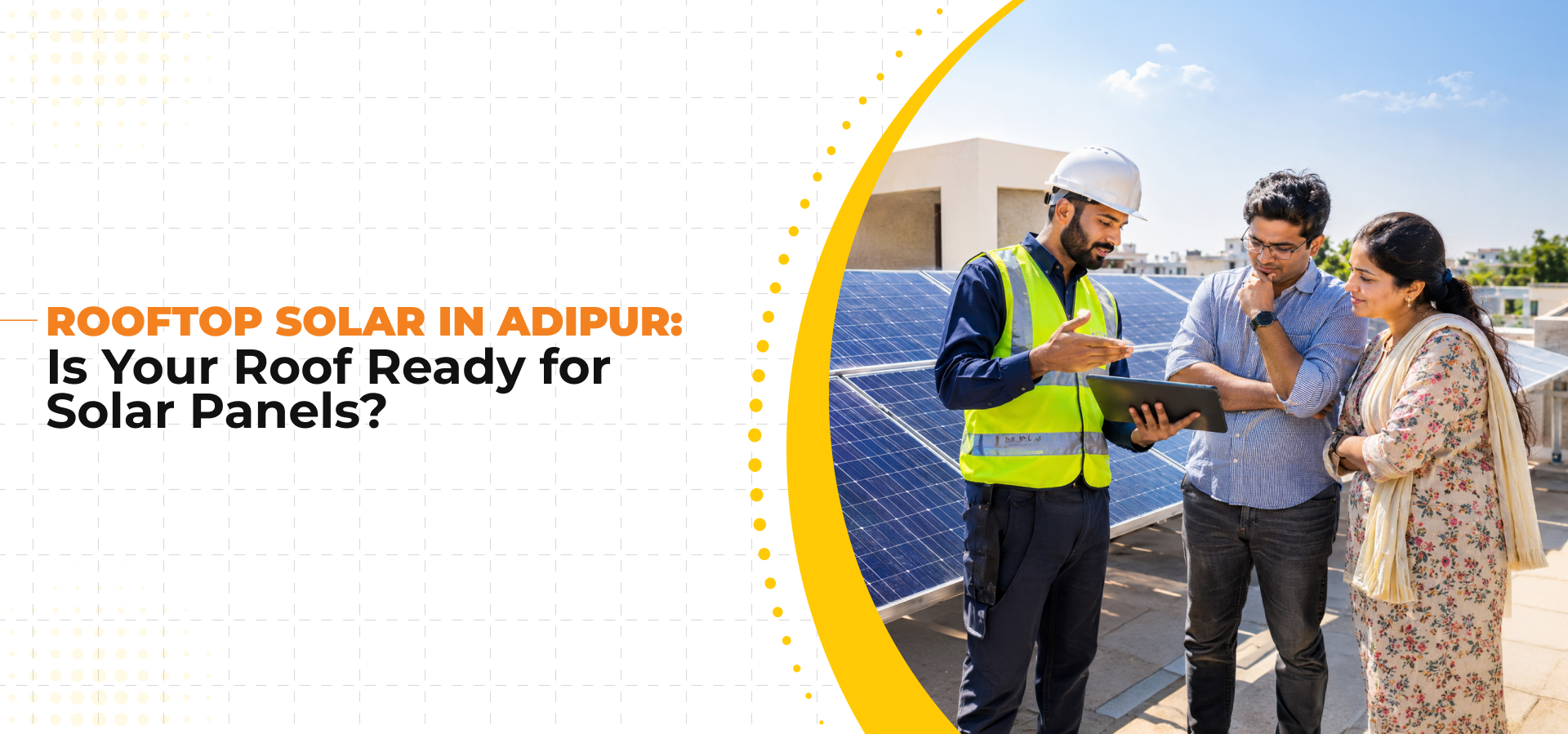
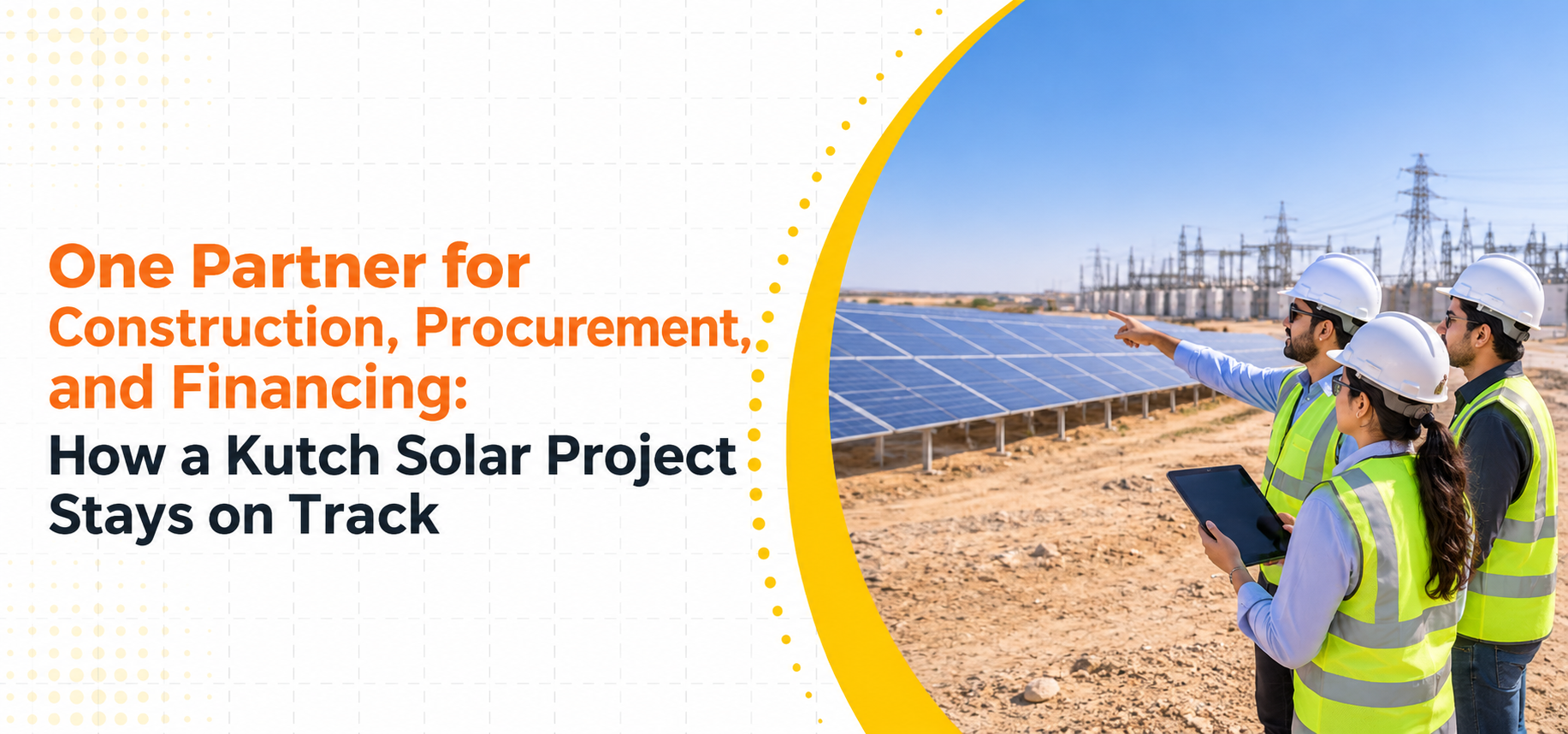
A solar project in Kutch rarely fails because of the sun. It stalls because a panel shipment arrives without the right DCR paperwork, a loan sanction waits on an installer's invoice, or a mounting structure designed for a generic roof meets a 50 m/s wind zone. Each handoff between a supplier, a contractor and a lender is a place where schedules slip and responsibility blurs.
This guide explains what a well-run solar installation in Kutch involves, what it typically costs, which subsidies apply and how a single partner handling construction, procurement and financing keeps a project on track. It is written for homeowners, shop and office owners, and factory managers across Bhuj, Gandhidham, Anjar, Mundra, Mandvi and Nakhatrana.
Why does Kutch suit solar power?
Short answer: Kutch has some of the strongest sunshine in Gujarat, with low cloud cover and long dry seasons. The same desert climate also brings heat, dust, salt and wind that a design must account for.
One regional estimate puts Kutch's average solar irradiance at roughly 5.6 to 5.9 kWh/m² per day, with more than 300 clear days a year. Across Gujarat, a 1 kW system is commonly estimated to generate about 1,400 to 1,620 units a year. Kutch estimates run higher, but published figures range widely (roughly 1,600 to 1,950 units per kW), so a site-specific yield estimate is better than a generic promise.
That resource is why rooftop solar in Kutch is attractive for households and businesses. It is also why design details matter more here than in a mild, cloudy district.
What does the Kutch climate do to a solar system?
Condition | Effect on the system | Design response |
Extreme summer heat | Panel voltage and efficiency drop; polymers and wiring age faster | Modules with good temperature coefficients; sound cable and junction-box specification |
Fine desert dust | Generation losses of roughly 10–25% if panels are left uncleaned (published estimates) | Planned cleaning schedule; monitoring to spot drops |
Salt-laden air (coastal talukas and the Rann belt) | Corrosion of frames, brackets, fasteners and terminals; sticky salt crust on glass | Hot-dip galvanised or aluminium structures, stainless steel fasteners, sealed enclosures |
High winds and cyclones | Uplift forces that can strip poorly anchored arrays | Wind-load design to IS 875, low tilt, edge setbacks, proper anchoring |
Seismic Zone V | Ground movement stresses rigid, heavy installations | Load spread across structural members, controlled flexibility |
A solar panel in Kutch faces conditions that are tougher than most of India, so the question is less "which brand?" and more "was the whole system engineered for this location?" Heat reduces output, abrasive dust can scratch glass if cleaned badly, and salt can bake into a hard film that blocks light.
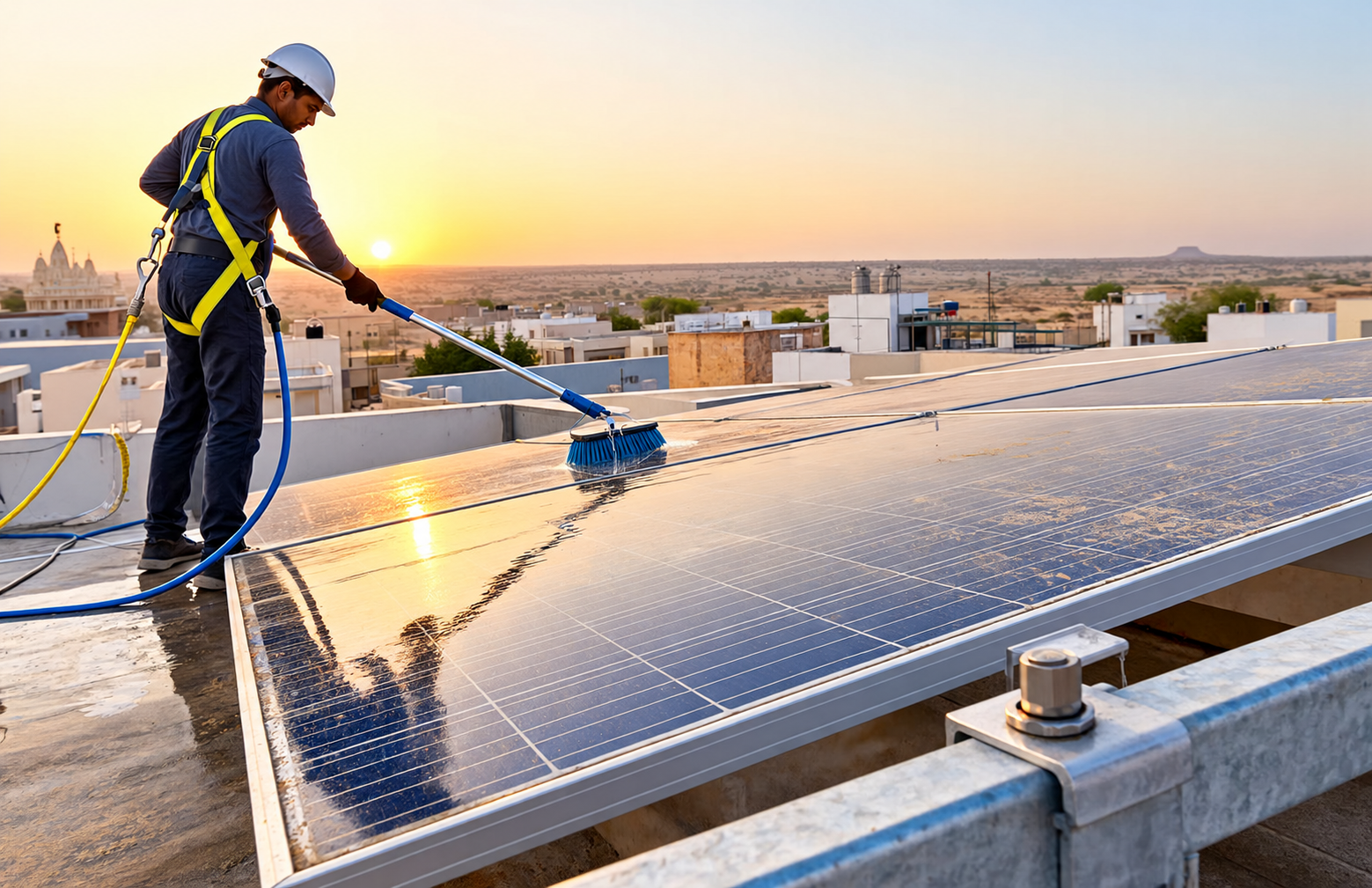
For dusty sites, published guidance suggests cleaning every 7 to 14 days, plus a quick wash after a dust storm. Clean early in the morning, use soft brushes and plain water, and avoid high-pressure jets that can force water past seals.
How does a Kutch solar project run from start to finish?
Short answer: Every project moves through site survey, design, approvals, procurement, construction, commissioning and net metering. Delays almost always happen at the boundaries between those stages.
Stage | Homes (1–10 kW) | Commercial and industrial |
Site survey | A few hours to 1–2 days | 1–3 days (longer for complex roofs) |
Design and proposal | 2–5 days | 1–4 weeks |
DISCOM approvals and documentation | 15–30 days | 2–6+ weeks |
Installation | 2–5 days | 3–6 weeks (about 100–500 kWp or more) |
Testing and commissioning | 1–2 days | 1–2 weeks |
Typical total | About 6–8 weeks under good conditions, up to 2–4 months | About 8–16 weeks |
These are industry-reported ranges, and actual timing depends on roof condition, equipment availability and DISCOM processing.
Why do projects stall when work is split across vendors?
When the designer, equipment supplier, installer and lender are separate companies, problems tend to follow a pattern:
Blame-shifting. If a component fails or arrives late, each party points to another, and the owner becomes the investigator.
Schedule mismatches. A procurement delay leaves the installation crew idle, which can trigger standby charges and change orders.
Funding freezes. A lender releases money against verified milestones. A missed document from the installer can pause the next payment, which delays procurement, which delays construction.
Warranty gaps. A supplier offers only the manufacturer's warranty, while the installer is responsible for workmanship. When performance falls short, nobody owns the whole system.
This is general industry reasoning, not a claim about any one contractor. It is the reason an integrated model exists. White Desert Power Projects, based on the Bhuj–Nakhatrana Highway in Nana Angiya, lists construction and installation, procurement of components, and financing and subsidy assistance as connected services. With one partner, the quantities ordered match the design, deliveries line up with the crew's schedule, and loan or subsidy paperwork is prepared alongside the technical documents rather than after them.

What should the construction stage include in Kutch?
Short answer: Beyond fitting panels to a roof, construction here should address wind, seismic load, corrosion, earthing and documentation.
White Desert's construction page describes four steps: site preparation, foundation work, module installation and system commissioning. Local conditions add several checks you can ask any contractor about:
Wind-load calculations. Structures in Kutch are typically designed for a basic wind speed of about 47–50 m/s under IS 875 (Part 3). Low tilt angles, wind deflectors and keeping panels back from roof edges reduce uplift.
Structural check. Seismic Zone V means weight must be spread across load-bearing members, not left on weak slab spans. For larger systems, DISCOMs commonly ask for an engineer's structural stability certificate, so confirm the current requirement before you sign.
Anchoring. On concrete roofs, chemical or mechanical anchors with proper sealing are preferred over relying on ballast alone. On metal sheds in port and industrial areas, frames should be fixed to the building's purlins, not just clamped to sheet metal.
Corrosion protection. Hot-dip galvanised steel (to IS 4759 / ISO 1461) or aluminium structures, stainless steel fasteners, and isolation between dissimilar metals. Ask for the coating thickness test report instead of accepting a verbal assurance.
Safety and protection. Surge protection, earthing pits and isolation switches in line with electrical inspection rules.
Roof space is also worth checking early. A rooftop system needs roughly 80–100 sq ft of shadow-free area per kW, with at least five hours of direct sunlight a day.
What should the procurement stage cover?
Short answer: Procurement is where quality is won or lost. The key checks are DCR and ALMM compliance, BIS/IEC certification, suitable technology for a hot climate, and clear warranty terms.
White Desert's procurement page describes a four-step process: requirement analysis, vendor evaluation, quality checks, and delivery and inventory coordination.
DCR panels. DCR (Domestic Content Requirement) means both the cells and the modules are made in India. DCR modules are mandatory to receive central subsidy under PM Surya Ghar, and officials can check module serial numbers during inspection. Non-DCR panels are generally limited to unsubsidised commercial and industrial systems.
Certifications to ask about:
Component | What to look for |
Solar modules | IS 14286 (IEC 61215), IS/IEC 61730 safety, ALMM listing where subsidy or government schemes apply |
Inverters | IS 16221 / IEC 62109 safety, anti-islanding protection (IEC 62116), grid-interface compliance |
Structures | Galvanising to IS 4759 / ISO 1461 with a test report |
Technology for heat and dust. N-type TOPCon modules generally lose less output in high temperatures than older designs, and dual-glass construction resists humidity and dust abrasion better than polymer backsheets. Bifacial gains depend on mounting and cleanliness, so they are not automatic.
Typical warranty ranges in India (check the actual documents you receive):
Item | Typical warranty |
Module product warranty | 10–12 years (some up to 15) |
Module performance warranty | 25–30 years |
String inverter | 5–10 years |
Mounting structure (anti-corrosion) | 5–10 years |
Installation workmanship | 1–5 years |
What subsidies and financing are available?
How does the PM Surya Ghar subsidy work for homes?
Short answer: Households receive central financial assistance of ₹30,000 per kW up to 2 kW, capped at ₹78,000 for systems of 3 kW and above, paid by direct bank transfer after commissioning.
System size | Central subsidy |
1 kW | ₹30,000 |
2 kW | ₹60,000 |
3 kW and above | ₹78,000 (maximum) |
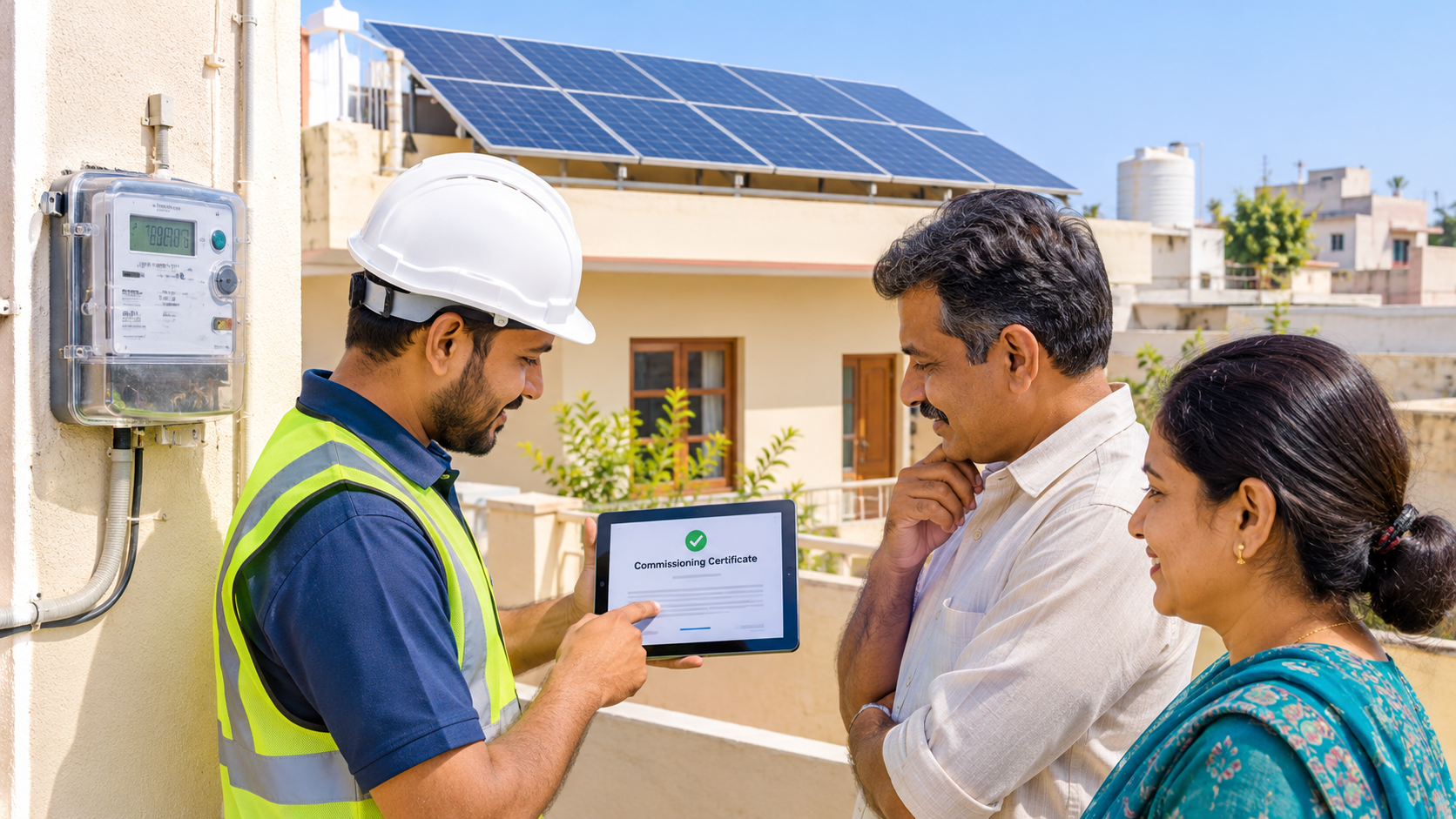
For households, PM Surya Ghar in Kutch follows the same national process as the rest of Gujarat. You apply on the national portal, your DISCOM (PGVCL for most of Kutch) checks feasibility, a registered vendor installs the system, the DISCOM inspects and fits the net meter, and the subsidy is credited once you upload your bank details against the commissioning certificate. The portal benchmark for credit is about 30 working days after that step.
Eligibility essentials:
Indian citizen who owns a residential house with a suitable roof (tenants can apply with an owner's NOC)
A valid domestic electricity connection in the applicant's name
A grid-connected system with DCR modules, installed by a vendor listed on the portal for your district
No earlier subsidy for the same installation
The scheme is currently reported to run until 31 March 2027, so check the official portal before you plan around a deadline. Keep your Aadhaar, a recent electricity bill, ownership proof, bank details and a photograph ready.
Choosing a vendor. You can only claim the subsidy through a registered installer for your district. Check the listing yourself on the portal before signing. White Desert's financing page lists subsidy assistance among its services, covering documentation and application support.
What is Gujarat's new top-up subsidy?
On 22 October 2026, Gujarat approved an additional state subsidy for residential systems. It applies only to systems commissioned on or after 22 October 2026, with installed DC capacity not exceeding 2.18 kWp. It limits the household's contribution to 10 percent of the benchmark cost, or 5 percent for SC/ST households.
Two practical points. The benchmark is a government reference figure (reported as ₹50,000 per kW for the first 2 kW), not necessarily a market price, so ask your installer to show in writing exactly what you will pay. Systems above 2.18 kWp still qualify for the central subsidy but not the state top-up. Reported conditions also include MNRE-approved DCR panels and a three-year bar on capacity expansion.
What financing options exist?
For homes, banks offer loans linked to the scheme, with collateral-free lending reported for smaller systems (up to about 3 kW). Interest rates and terms differ by bank and credit profile, so confirm them directly.
Businesses do not receive a direct capital subsidy for rooftop solar in Gujarat, but they have other levers:
CAPEX (you own the plant) | OPEX / PPA (developer owns the plant) | |
Upfront cost | High (cash or loan) | None |
Electricity cost | Lowest over the long term | Fixed tariff, typically below the DISCOM rate |
Maintenance | Yours (or via a paid contract) | Developer's |
Tax depreciation | Claimed by the business | Claimed by the developer |
Contract | None | Long-term, often 15–25 years |
Best for | Profitable firms that own their premises | Capital-constrained firms or tenants |
Accelerated depreciation (reported at 40% for solar assets in year one) is available only to businesses that own the plant. Tax rules were restructured in 2026, so ask your chartered accountant to confirm the current provision and treatment. MSME-focused green loans, SIDBI and IREDA schemes also exist, with wide differences in rates, margins and collateral.
When financing sits with the same partner as construction, the technical documents lenders require, such as drawings, quotations and completion reports, come from one team working to one schedule.
How do needs differ for homes, shops and factories?
Homes
Residential solar in Kutch usually means a grid-connected rooftop system of 2–5 kW. An on-grid system is the economical choice where the grid is reliable and it is the only type eligible for the central subsidy. A hybrid system adds a battery for outage-prone pockets but costs considerably more per kW.
Shops, offices and institutions
Commercial solar in Kutch suits businesses with strong daytime consumption, such as showrooms, hospitals, schools, cold stores and offices in Bhuj and Gandhidham. Payback is driven by commercial tariffs, and the ownership model (CAPEX or OPEX) decides who benefits from depreciation.
Factories, ports and warehouses
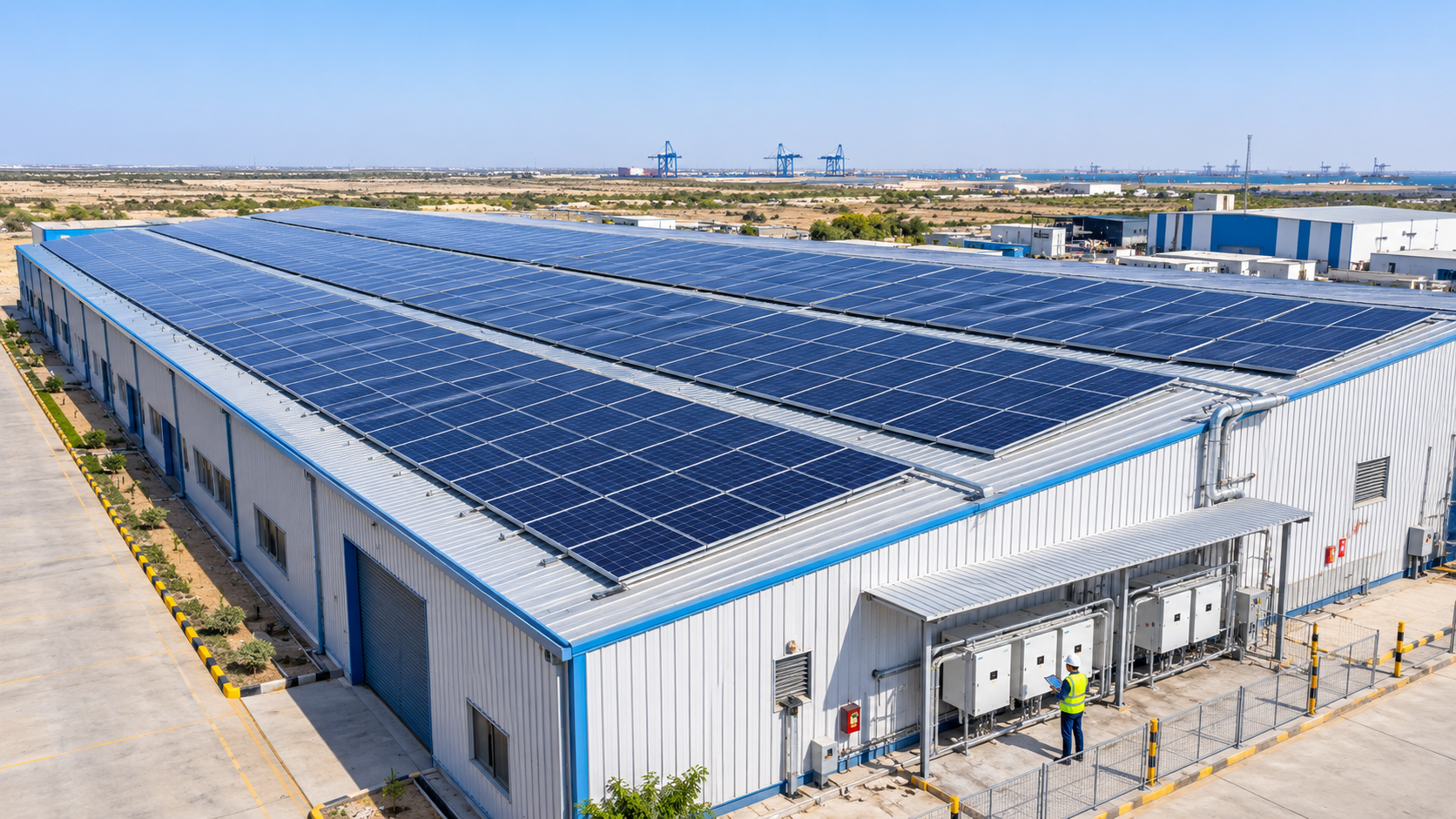
Industrial solar in Kutch matters most around Mundra, Anjar and Gandhidham, where large roofs, heavy machinery and long operating hours meet. Salt, cement, textile, engineering and port-related activities all consume large amounts of power. Metal-shed roofs need purlin-based fixing and a structural check, and plants near the coast need the highest corrosion specification.
What does solar cost in Kutch, and how long does it take to pay back?
Short answer: Published 2026 market estimates put home systems at roughly ₹50,000–75,000 per kW before subsidy, and commercial and industrial systems at roughly ₹35,000–58,000 per kW, falling as size increases.
Segment | Indicative cost before subsidy | Reported payback |
Homes (1–5 kW) | ₹50,000–75,000 per kW | About 2–5 years with subsidy (some estimates up to 7) |
Small commercial (25–50 kW) | ₹42,000–55,000 per kW | About 2–4 years |
Mid-size (50–200 kW) | ₹52,000–58,000 per kW | About 2–4 years |
Large industrial (200 kW–2 MW+) | ₹35,000–54,000 per kW | About 2.3–4 years |
These are general market ranges, not White Desert prices. Real quotes depend on roof type, structure specification, component choice and your electricity tariff. Treat a quote that is far below range as a prompt to ask what has been left out, such as corrosion-grade structures, structural certification or net-metering support.
How do you choose the right solar partner in Kutch?
Anyone searching for the best solar rooftop company in Kutch will find plenty of claims, so judge by evidence instead of slogans. Ask to see:
The company's listing on the PM Surya Ghar portal for your district (for homes)
Wind-load and structural calculations for your roof
DCR/ALMM proof and BIS/IEC certificates for the exact modules and inverters quoted
An itemised quotation showing what you pay after subsidy
Warranty documents for modules, inverters, structures and workmanship, and who is responsible for each
A maintenance and cleaning plan suited to desert dust and salt
Who handles net-metering paperwork and what the realistic timeline is
If you are weighing a single accountable partner, White Desert Power Projects can be reached through its contact page or at its office on the Bhuj–Nakhatrana Highway in Nana Angiya, Nakhatrana (listed hours Monday to Friday, 9am–6pm). Whatever you decide, ask for a site-specific proposal before committing.